Pore Primer Days: Afternoon Touch-Ups to Evening Removal
On a day you wear pore primer, press off oil in the afternoon and add only a thin layer where makeup has faded. At night, melt it off first, then wash once more with a gentle cleanser.
What this note covers8 sections
- How do you touch up makeup in the afternoon once it has broken down?
- Can you use blotting paper on your face often?
- Do powders and lotions clog your pores?
- In what order should you take off primer at night?
- How many days should you test a new primer, and how?
- A one-week log for primer days
- When should you get a dermatologist to look at it?
- Evidence behind this guide
| Item | Detail | Basis |
|---|---|---|
| Hours in makeup | Advises cutting down the time you keep makeup on and removing it thoroughly | Seoul National University Hospital · institution |
| Powder | In a case-control survey of 151 people, powder use stayed a significant risk factor after adjustment (OR 3.47, self-reported association) | 2025 PMID 40765696 · B |
| Finished-product test | When finished products were patched for 4 weeks on 6 people prone to comedones, products with comedogenic ingredients did not always cause comedones | 2006 PMID 16488305 · B |
| Reaction right after applying | Immediate stinging and redness that fade within 1 hour could be picked up with a short 20-minute occlusive patch | 2020 PMID 32279349 · A |
| Evening cleanse | Says double cleansing can help on days you wear sunscreen or makeup, since follicles can get clogged | KDCA · institution |
How do you touch up makeup in the afternoon once it has broken down?
Take off the oil first, then add a thin layer only where makeup has worn away. If you keep piling powder or cushion foundation on top, both the amount that settles into pores and the amount you have to remove at night go up.
Where makeup breaks down first in the afternoon differs from person to person. In a 2013 study of 709 acne patients, combination was the most common self-reported skin type, and dryness, tightness and shine were the symptoms that decided how people judged it. If you note whether your forehead, nose or cheeks get shiny first when you check the mirror after lunch, the next morning you can adjust the amount, for example by placing a thin layer of primer only on that area. Seoul National University Hospital in Korea also advises cutting down the time you wear makeup, so taking it off earlier, right after work or school, on more days is another option.
Can you use blotting paper on your face often?
The sources behind this article have no study that tested how many times a day blotting paper is fine to use. When you do use it, press it lightly onto shiny spots and lift it off rather than rubbing.
The Korean Dermatological Association lists friction and mechanical irritation as factors that can bring on or worsen acne. Swiping blotting paper down your T-zone or pushing shine away with your fingers falls into that category. If you write in the log each time you blot, such as before a meeting, after lunch or after a workout, you’ll see when shine builds up and can cut back by pressing just once before that time.

Do powders and lotions clog your pores?
It varies by product, so the type alone doesn’t tell you whether it will clog. In a 2025 survey of acne patients and controls (151 people), cleanser, foundation and powder use were linked to acne risk, and after adjusting for other factors, only powder stayed significant (OR 3.47).
This result is a self-reported association, so it can’t be taken as proof of cause. On the other side, in a 2006 test where finished products were patched on 6 people prone to comedones for 4 weeks, products containing comedogenic ingredients did not always produce comedones. In a 2012 test where a mineral powder containing trace nickel was patched for 48 hours on 23 people with a nickel allergy, 74% reacted to the nickel test reagent, but none reacted to the powder. That’s why your own skin log is more useful than the ingredient list. If makeup often settles into your pores, split your afternoon touch-ups into days you add powder and days you only press off oil, and compare them one week each.
In what order should you take off primer at night?
Melt, rinse, then wash once more: double cleansing is the baseline. The Korea Disease Control and Prevention Agency (KDCA) notes that on days you wear sunscreen or makeup, follicles can get clogged and acne may become more likely, so double cleansing can help; it also says to wash makeup off twice a day with a mild, low-irritation cleanser and water.
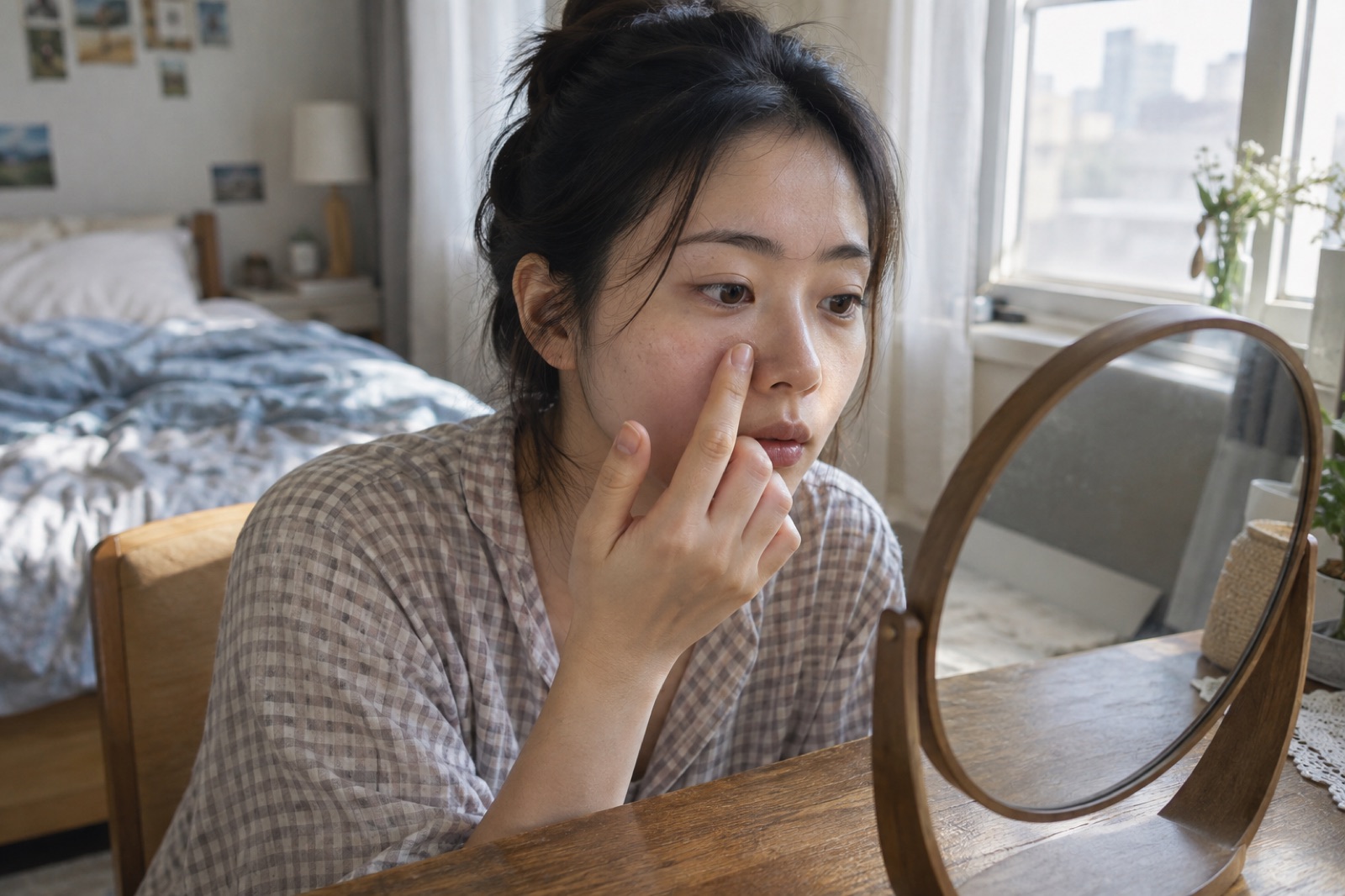
On the sides of the nose and inner cheeks, where primer sat thickest, spend a little longer working in the first-step cleanser with your fingertips. Don’t press hard or rub with a cotton pad. After washing, check in the mirror for makeup left in your pores. If some is left, note in the log whether you used less primer the next day or spent longer on the first cleanse.
How many days should you test a new primer, and how?
Look at reactions right after applying and reactions a few days later separately. A 2020 study reported that immediate reactions like stinging and redness that fade within 1 hour were hard to spot with standard patch testing, could be picked up with a short 20-minute occlusive patch, and that their strength correlated with reactions in real use.
At home, apply a thin layer on one side of your jawline and note stinging or redness after 20 minutes and after 1 hour. If there’s no problem, use it on one side of your face only for 1 week. Don’t switch any other base products during that time, or you won’t be able to read the log.
A one-week log for primer days
| Day | Amount and area | Afternoon touch-up (time, method) | Blotting count | Removal time, method | Makeup left in pores | Breakouts next day |
|---|---|---|---|---|---|---|
| Day 1 | Beside nose, inner cheeks, 1 pea-size | 2 p.m., pressed off oil only | 2 | 7 p.m., first cleanser + wash | None | None |
| Day 2 | Same | 3 p.m., added powder | 1 | 10 p.m., same order | A little beside nose | None |
| Day 3 | Same | No touch-up | 3 | 8 p.m., same order | None | 1 on chin |
| Days 4–7 | Fill in yourself |
As in the example, put the days you added powder next to the days you didn’t, and the days you removed makeup late next to the days you removed it early. Comparing the “makeup left in pores” and “breakouts next day” columns side by side helps you decide whether to change your afternoon touch-up or the time you take makeup off.
When should you get a dermatologist to look at it?
- If the area where you applied it turns red, itchy or swollen, stop using it and see a dermatologist.
- If breakouts keep appearing in the same spot for more than 2 weeks even after you stop the primer and change how you remove it, get it checked by a dermatologist.
- If painful, hard bumps or pus keep coming back, a dermatology consultation is recommended.
Evidence behind this guide
- In a 2025 survey comparing acne patients and controls (151 people; PMID 40765696), only powder use stayed a significant risk factor after adjustment (OR 3.47, self-reported association).
- In a 2012 patch test on 23 people with a nickel allergy (PMID 22404196), 74% reacted to the nickel test reagent, but none reacted to the mineral powder.
- In a 2020 cosmetic formulation study (PMID 32279349), stinging and redness that fade within 1 hour could be picked up with a short 20-minute occlusive patch, and their strength correlated with reactions in real use.
Frequently asked questions
How do you touch up makeup during the day without it getting cakey?
A safe order is to press off the oil on shiny spots first, then add a thin layer only where makeup has worn off. If you keep stacking layers on top, there is more to remove at night. Seoul National University Hospital in Korea advises cutting down the hours you wear makeup and removing it thoroughly.
Is it okay to use blotting paper every day?
The sources behind this article include no study that tested how often blotting paper can be used. When you use it, press it on lightly and lift it instead of rubbing. The Korean Dermatological Association lists friction and mechanical irritation as factors that make acne worse. Writing down how many times you blot each day also shows when shine peaks.
Does setting powder or lotion clog pores?
It depends on the product. In a 2025 survey comparing acne patients and controls (151 people), only powder use stayed a significant risk factor after adjusting for other factors (OR 3.47). Because this is a self-reported association, it can't show that powder is the cause. In a 2006 test on 6 people prone to comedones, finished products containing comedogenic ingredients did not always cause comedones, so in the end you have to check on your own skin.
Sources
- Cosmetic use and acne risk: case-control survey, 151 people, 2025 (PMID 40765696)B
- Reassessing the comedogenicity concept: 4-week patch test of finished products, 6 people, 2006 (PMID 16488305)B
- 20-minute patch test for immediate stinging and redness from cosmetics, 2020 (PMID 32279349)A
- Patch test reactions to mineral powder in 23 nickel-sensitized people, 2012 (PMID 22404196)B
- Self-perceived skin type and sebum levels in 709 acne patients, 2013 (PMID 23279191)B
- Seoul National University Hospital N Medical Information — Acne (Korean)Institutional
- Korea Disease Control and Prevention Agency, National Health Information Portal — Acne (Korean)Institutional
- Korean Dermatological Association — Acne vulgaris (Korean)Institutional
Videos and forum posts never count as evidence for a fact here. Full rules: Editorial policy