Dark Spots on Buttocks? Track Sitting Hours, Clothes and Scrubbing
For dark spots on your buttocks, write down how long you sit, what you wear, and how hard you scrub in the shower, then compare photos once a month to see which way the color is going.

What this note covers7 sections
| Daily situation | Why you log it | Basis |
|---|---|---|
| Long hours of pressure from sitting | When skin is pressed or rubbed and sweat builds up, its defenses break down and boils form more easily | KDCA Boils (updated 2026) · agency |
| Scrubbing in the shower | On the side scrubbed with a nylon towel twice a day for 2 weeks, skin water loss went up (6 people) | 2018 PMID 29243811 · B |
| Picking or scratching bumps | Named as a risk factor for dark marks after acne | 2021 PMID 34880967 · B |
| Friction itself | Pigment changes caused by friction have their own name and have been studied (52 people) | 2012 PMID 23248362 · B |
| How often to compare | Half or more of dark marks after acne last a year or longer → one photo a month | 2016 PMID 26813513 · B |
Why start by logging how many hours a day you sit?
Your buttocks carry your body weight and rub against your clothes the entire time you’re seated, so sitting time is friction time. To guess why the color darkened, you first need to know how many hours a day that adds up to.
The National Health Information Portal of the Korea Disease Control and Prevention Agency (KDCA) explains that when skin is pressed or rubbed, or when you sweat heavily, the skin’s defenses are damaged and boils form more easily. A student sitting in the library more than 10 hours a day before exams, an office worker in a desk chair all day, and someone who drives long distances all have different conditions. If you write down your total sitting time along with how many times you got up, you can match lifestyle changes to your photos later.
What should you note about your chair and clothes?
Two things are enough: whether you sweat against it, and how tight it is. Even over the same 8 hours, sitting on a chair that doesn’t breathe in tight pants stacks pressure on top of sweat.
For the chair, note whether it has a surface that doesn’t absorb sweat, like faux leather, and whether you use a cushion or cover. For clothes, note in that day’s column whether you wore close-fitting bottoms like jeans or leggings, or loose cotton. If you sat for a long time in wet clothes after a workout, log that time separately too. These items are an editorial rule that turns the pressure, friction and sweat the KDCA points to into everyday situations; the sources behind this guide include no study that directly compared chairs or clothing fabrics.

How hard are you scrubbing in the shower?
If you tend to scrub your buttocks hard with an exfoliating towel or a rough shower tool, that adds one more source of friction. Give your shower tool and pressure a column of their own in the log.
In a 2018 study, 6 healthy adults washed one forearm with a nylon towel and soap and the other with soap alone, twice a day for 2 weeks; on the towel-scrubbed side, skin water loss went up and natural moisturizing factor went down (grade B, small study on arms). It didn’t look at buttocks, but it does suggest that repeated scrubbing can weaken the outer layer of skin. Spread lather with your hands, and press water off with a towel instead of rubbing.
How do you keep track of dark marks left where bumps were?
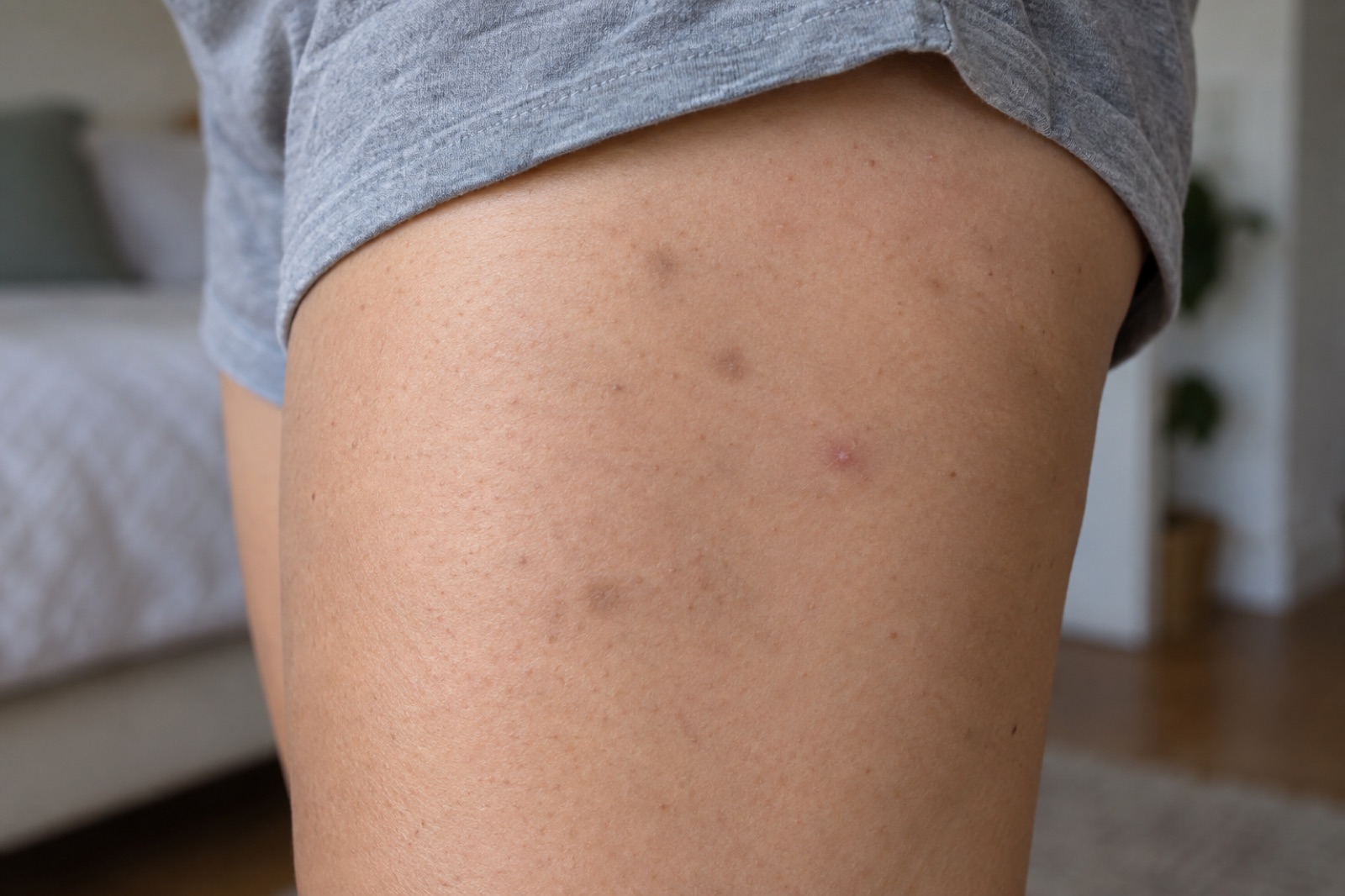
Color left where a bump cleared often lasts a long time, so check only its direction with a photo taken under the same conditions once a month. In between, the key to the log is not picking or scratching new bumps.
In a 2016 study of 324 acne patients across seven Asian countries, 58.2% had dark marks after acne, and in half or more of them the marks lasted a year or longer, with 22.3% lasting 5 years or longer. The Korean Dermatological Association also explains that dark marks after acne can persist for a year or more. Some pigment comes from friction alone — enough that a 2012 study focused on 52 patients with frictional dermal melanosis. If a wide area darkened where there were never any bumps, give the friction side of your log more weight.
One-month daily-life log
| Week | Average daily sitting time and times you stood up | Chair and bottoms (sweaty, tight) | Shower tool and scrubbing pressure | Days you picked or scratched | New bumps |
|---|---|---|---|---|---|
| Week 1 | |||||
| Week 2 | |||||
| Week 3 | |||||
| Week 4 | |||||
| End of month | One photo, same light and distance | Compare side by side with last month’s photo |
Once you have three months of end-of-month photos, check whether the color got darker in months with long sitting hours and many picking days. If the color keeps spreading even after you changed your habits, the next step is taking your log to an appointment.
When is it time to bring it to a dermatologist?
- If a painful, firm lump forms where you sit or fills with pus, don’t squeeze it; get it checked. The KDCA warns that forcing it out before it comes to a head can make it worse.
- If red streaks spread out from the lump or nearby lymph nodes feel sore, get care right away.
- If three months of logging show the color getting darker and wider even after you changed your habits, have a dermatologist find the cause.
- If itching, oozing or scaly flakes come along with it, it may be a different skin condition, so consider an appointment.
What this guide is built on
- In a 2016 survey of 324 acne patients in seven Asian countries, 58.2% had dark marks after acne, and 22.3% lasted 5 years or longer.
- In a 2018 study of 6 healthy adults, the forearm scrubbed with a nylon towel twice a day for 2 weeks lost more water than the one washed with soap alone.
- A 2012 study of 52 patients with frictional dermal melanosis shows that friction can be one cause of pigment changes.
Frequently asked questions
How do you deal with dark spots on your butt from chair friction?
The basics are cutting the time the area is pressed and rubbed. Korea's KDCA explains that pressure, friction and heavy sweating damage the skin's defenses, making problems like boils more likely. Log your sitting time, how often you stood up, and how long you stayed in sweaty clothes for a month, and have a dermatologist check it if the color spreads widely or you're unsure what it is.
Do butt acne scars and dark marks fade over time?
Flat color left behind can fade with time, but it often takes a long while. In a 2016 survey of 324 acne patients in seven Asian countries, half or more of the dark marks lasted a year or longer and 22.3% lasted 5 years or longer. Not picking at new bumps comes first, and if a scar has sunk below the surface, a dermatologist decides how to manage it.
Why do pimples on my butt leave dark marks?
Most likely it's post-inflammatory hyperpigmentation: color that stays behind as a bump settles down. A 2021 study of risk factors for dark marks after acne named being female, darker skin tone, severe acne, sun exposure, and squeezing or scratching. If the spot is rubbed every time you sit, log friction too.
Sources
- Korea Disease Control and Prevention Agency (KDCA) National Health Information Portal — Cellulitis and boils (Korean, updated 2026-08-13)Institutional
- Korean Dermatological Association — Acne vulgaris (Korean)Institutional
- Repeated friction washing and loss of stratum corneum components, 2018 (PMID 29243811)B
- Frictional dermal melanosis in 52 patients, 2012 (PMID 23248362)B
- Risk factors for post-acne hyperpigmentation, 2021 (PMID 34880967)B
- Frequency of post-acne hyperpigmentation across seven Asian countries, 2016 (PMID 26813513)B
Videos and forum posts never count as evidence for a fact here. Full rules: Editorial policy