Neck Acne: Reset What Touches Your Neck and How Far You Rinse
If neck acne keeps coming back, first reset which products reach your neck and how far down you rinse, then check whether it is really heat rash or a contact reaction.

What this note covers7 sections
- Products that reach your neck: how far should you cut back?
- How do reactions to perfume and necklaces differ from acne?
- Are you rinsing down under your jaw when you wash?
- Is it heat rash or neck acne?
- Step table: resetting neck products and your rinse area
- When should you see a dermatologist about neck bumps?
- What this article is based on
| What touches your neck | What to look at when you reset it | Basis |
|---|---|---|
| Perfume and scented body products | Of 27 people who had a skin reaction after using cosmetics, 85.18% tested positive to a fragrance allergen | Patch-test observational study · B (2019) |
| Necklaces and metal | Among 1,236 adults in the general population, nickel sensitization was the most common at 17.6% | Population-based study · B (2007) |
| Sweat and heat | 70% of 120 acne patients had itching, and the things that made it worse were sweat 71%, heat 62% and stress 31% | Observational study · B (2008) |
| Heat rash | The red type of heat rash tends to appear on the trunk, the inner bends of the arms and legs and the neck, comes with severe itching, and staying cool is the basic step | Korean Dermatological Association · Institution |
| The neck in adult women | Adult acne in women tends to appear on the chin, jawline and neck | Korean Dermatological Association · Institution |
Products that reach your neck: how far should you cut back?
Sketch once how far down your neck the cream and sunscreen you spread from your face, the perfume you spray on your neck and the body lotion you use after a shower actually reach. If a product overlaps with where the bumps are, pause just that one for 2 weeks and log what changes.
The Korean Dermatological Association lists overly oily or pore-clogging cosmetics, friction or mechanical irritation, and heavy sweating as things that can bring on or worsen acne. The acne guide from the Korea Disease Control and Prevention Agency (KDCA) also recommends choosing products labeled non-comedogenic or non-acnegenic. Leftover face products easily build up thick on the neck, so cut back by keeping only toner and moisturizer on your neck and removing the rest for a while.
How do reactions to perfume and necklaces differ from acne?
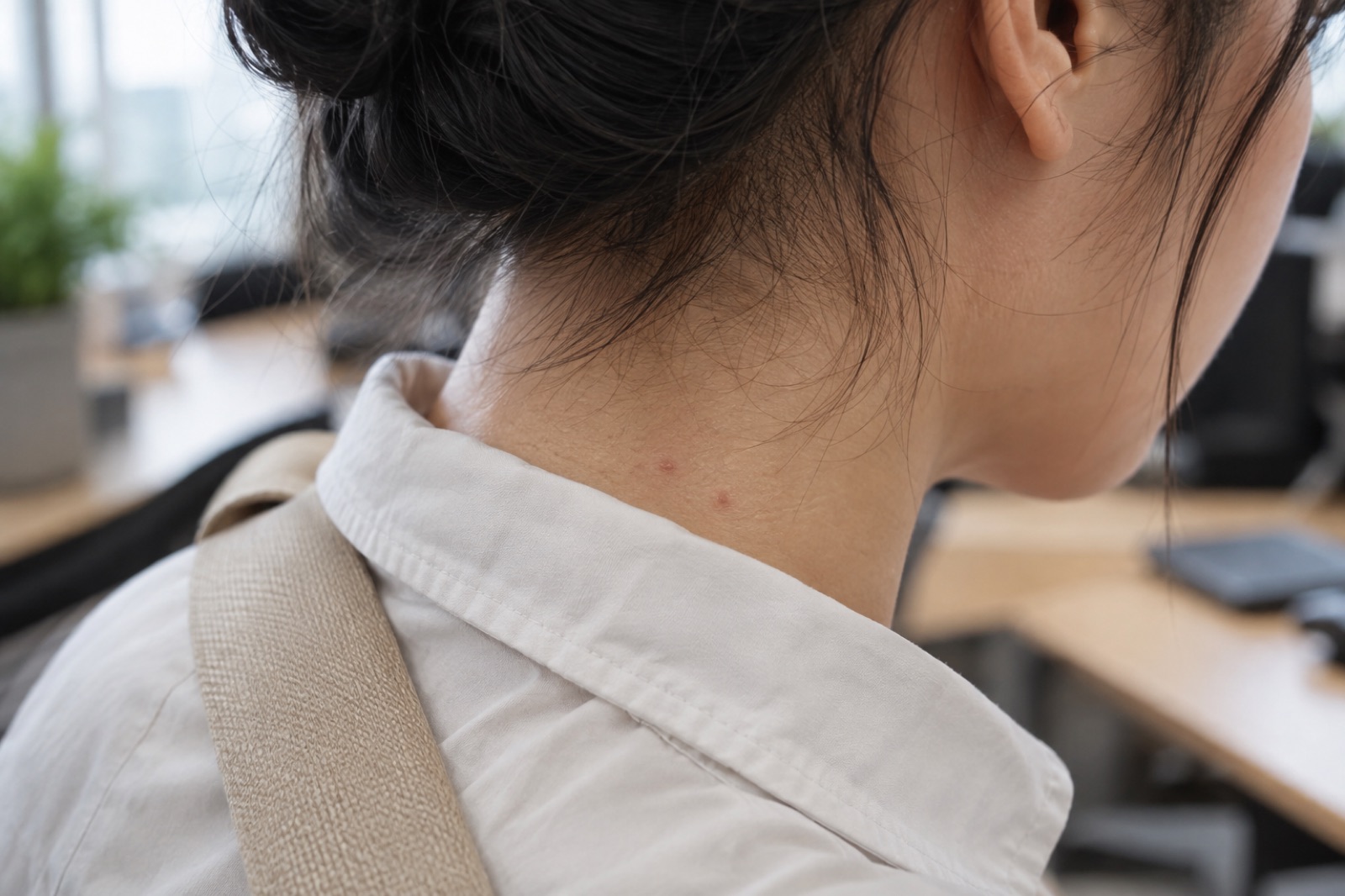
If itching and redness spread where you spray perfume or along a necklace chain, think of a contact reaction before acne. As the KDCA explains, a contact reaction typically turns red where the substance touched, so check whether the red area matches where you sprayed or the shape of the chain.
In a 2019 study that ran fragrance-series patch tests on 27 people who had a skin reaction after using cosmetics, 85.18% tested positive to at least one fragrance allergen. A 2007 study of 1,236 adults in the general population of Norway found nickel sensitization was the most common at 17.6%, and in women, ear piercing was a risk factor for nickel sensitization (RR 3.30). If you usually spray perfume on your neck before work or wear the same necklace every day, clear these two boxes first.
Are you rinsing down under your jaw when you wash?
Face-wash foam, sunscreen and cleansing residue easily stay under the jawline and on the front of the neck, so check whether you splash water down onto your neck when you rinse. Look the same way at whether conditioner or body wash runs down your neck in the shower and stays there.
The KDCA acne guide explains that washing gently with lukewarm water twice a day is enough. If you bend only your face over the sink to rinse, water barely reaches under your jaw and the sides of your neck, so for the last two or three rinses, use your palms to draw water down from under your jaw to just above your collarbones. On rushed days, like a quick gym shower, just check off whether you rinsed your neck.
Is it heat rash or neck acne?
If small red bumps pop up on your neck all at once on a hot day or after exercise, itch a lot and settle once you cool down, it leans toward heat rash. If they come up one at a time over several days and grow around a pore, think acne first.
The Korean Dermatological Association explains that the red type of heat rash tends to appear on the trunk, the inner bends of the arms and legs and the neck, comes with severe itching, and that the basic step is staying somewhere cool so you don’t sweat more. Itching doesn’t rule out acne, though. In a 2008 study of 120 acne outpatients, 70% reported acne-related itching, and the factors that made the itching worse were sweat (71%) and heat (62%).
Step table: resetting neck products and your rinse area
| Period | What to do | What to log |
|---|---|---|
| Day 1 | List everything that touches your neck: cream, sunscreen, perfume, body lotion, hair products, necklaces | The list and how far each one goes on |
| Days 1–14 | After washing, only toner and moisturizer on your neck; perfume on wrists or inside clothes; necklaces off | Number of new bumps, itching |
| Every evening | At the end of washing, rinse with lukewarm water from under the jaw to just above the collarbones | Check off whether you rinsed |
| Hot days and workout days | Wipe off sweat, cool down somewhere cool, then check how the bumps change | How long they took to settle |
| Days 15–21 | Bring back what you removed, one item every three days | Days bumps came back and which product |
Choose the order for bringing things back by what is easiest to drop, not by what you’ve used longest. If redness or bumps return where it touched within three days of bringing a product back, mark that product on your list.
When should you see a dermatologist about neck bumps?
- If the skin stays red, cracks or oozes in the shape of where perfume or a necklace touched even after you stopped using them, have a dermatologist find the substance behind it.
- If itchy bumps keep spreading for days even after cooling down, consider seeing a dermatologist.
- If a deep, hard lump on your neck stays the same for weeks or grows and hurts, don’t squeeze it; see a dermatologist.
- If new bumps keep appearing on your chin and neck after following the step table for 3 weeks, talk to a dermatologist.
What this article is based on
- In a 2019 fragrance patch-test study, 85.18% of 27 people who had a skin reaction after using cosmetics tested positive to a fragrance allergen.
- In a 2007 population-based study in Norway (1,236 adults in the general population), the most common contact allergen was nickel, at 17.6%.
- In a 2008 study of 120 acne outpatients, 70% had itching, and the factors that made it worse were sweat at 71% and heat at 62%.
Frequently asked questions
Do breakouts on the neck, chest and back need the same care as the face?
The basics of washing gently and not squeezing are the same, but what touches the skin differs. The Korean Dermatological Association explains that acne is most common on the face, where oil glands are dense, and over time can appear on the neck, back and chest too; the body adds clothing, sweat and body products, so log what touches each area separately.
Are itchy bumps on my jawline and neck acne too?
Itching alone can't tell you. In a 2008 study of 120 acne patients, 70% had itching, and heat rash and contact reactions itch too. Check whether the bumps came up all at once on a hot day and settled somewhere cool, and whether the redness follows the shape of where perfume or a necklace touched.
Why can I feel little oily bumps on my neck?
The evidence behind this article has no study that checked whether small bumps you can feel on the neck come from oil. The Korean Dermatological Association explains that adult acne in women tends to appear on the chin, jawline and neck, so note whether the bump centers on a pore and how its size changes, and if a hard lump stays the same for weeks, have a dermatologist check it.
How should I handle acne on my chin and neck?
Think of the chin and neck as one zone, and start by sorting out the list of products that touch that zone and how far you rinse when you wash. Log for 2 weeks whether you spread face cream and sunscreen down to your neck and whether water reaches under your jaw when you rinse, and you'll see where to make changes.
Sources
- Hypersensitivity reactions seen with fragrance-series patch testing, 2019 (PMID 31807444)B
- Contact sensitization in the general adult population of Norway, 2007 (PMID 17177703)B
- Frequency and characteristics of itch in acne, 2008 (PMID 18631277)B
- Korean Dermatological Association — Miliaria (heat rash) (Korean)Institutional
- Korean Dermatological Association — Acne vulgaris (Korean)Institutional
- Korea Disease Control and Prevention Agency (KDCA) National Health Information Portal — Acne (Korean)Institutional
- Korea Disease Control and Prevention Agency (KDCA) National Health Information Portal — Irritant contact dermatitis (Korean)Institutional
Videos and forum posts never count as evidence for a fact here. Full rules: Editorial policy
What to check when choosing a product for this routine
Check the criteria below before the product name. Each item can be found on the full ingredient list or in the product description.
| Item | What to look for | Why |
|---|---|---|
| Fragrance | Whether fragrance or scent ingredients appear in the full ingredient list, and where | When you spread something down to your neck, your log can show whether you cut back on scent ingredients that touch it |
| pH on the label | Whether a mildly acidic range (around pH 4.5–6.5) is listed | It gives you a basis for comparison when you apply the same product to your face and neck after washing |
| Non-comedogenic label | A non-comedogenic label, or published results on pore-clogging potential | You can match it against the label Korea's disease control agency suggests looking for |
| Testing disclosure | Whether the brand says how irritation was tested | Results vary by person, but it gives you one more point to compare products on |
Product from this site's operator · KW Cosmetic Content Team
Revive Therapy N.F TonerCosmetics do not replace the diagnosis or treatment of a skin condition.