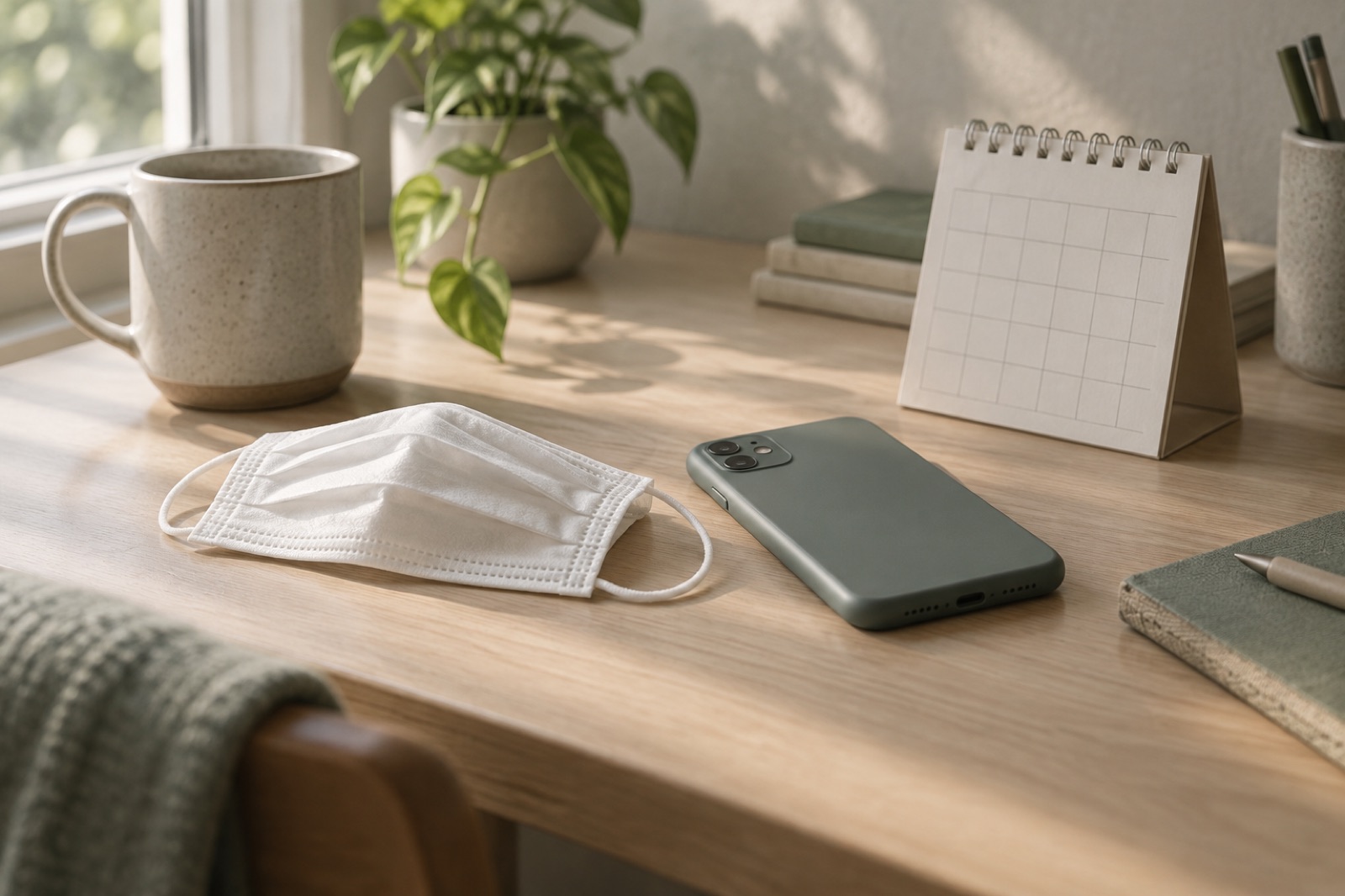
Maskne on Long Mask Days: A Swap, Break and Moisturizer Schedule
On long mask days, plan a schedule: a thin layer of moisturizer before you put it on, swaps and short breaks during the day, and a gentle face wash after it comes off.
What this note covers7 sections
- What should you put on before the mask, and how much?
- How often should you swap it, and when should you take a short break?
- What order should you wash in after the mask comes off?
- Is the bump on your cheek acne or an irritation reaction?
- Schedule for a long mask day
- When is it time to have a doctor check your mask area?
- What this article is based on
| Time or situation | What goes into the schedule | Basis |
|---|---|---|
| Hours worn per day | 55.4% of 101 health workers had acne, 58.9% of those cases were new, and daily wearing time was a risk factor | Observational study · B (2022) |
| How long and how often | In a survey of 389 adults, 46% had a skin reaction after wearing a mask, and longer, more frequent wear came with more skin damage | Cross-sectional survey · B (2022) |
| Where it shows up | In a survey of 2,326 people, 44.4% had mask-related skin problems, and the cheeks were the most common spot at 46.8% | Cross-sectional survey · B (2022) |
| Covered, damp skin | Irritation reactions happen more easily when skin touched by an irritant is covered, too hot and humid, or already damaged | KDCA (Korea) · Institution |
| Sunscreen | Apply 20 to 30 minutes before going outdoors, reapply every 2 to 3 hours; the standard amount is 2 mg per cm² | Korean Dermatological Association · Institution |
What should you put on before the mask, and how much?
After washing, apply just one thin layer of moisturizer, and if you’ll be outdoors, put on sunscreen 20 to 30 minutes before heading out so it has time to sink in. Stacking several thick layers under a mask may only add more material touching your skin in a closed space.
The National Health Information Portal of the Korea Disease Control and Prevention Agency (KDCA) explains that irritation from contact happens more easily when the skin an irritant touches is covered, too hot and humid, or already damaged. The inside of a mask is exactly that setting, so it is best not to test a new product right before you put one on. The Korean Dermatological Association gives the standard sunscreen amount as 2 mg per cm²; for the cheeks and chin under the mask, spread it in two passes instead of one heavy one, and wait for it to absorb before you put the mask on.
How often should you swap it, and when should you take a short break?
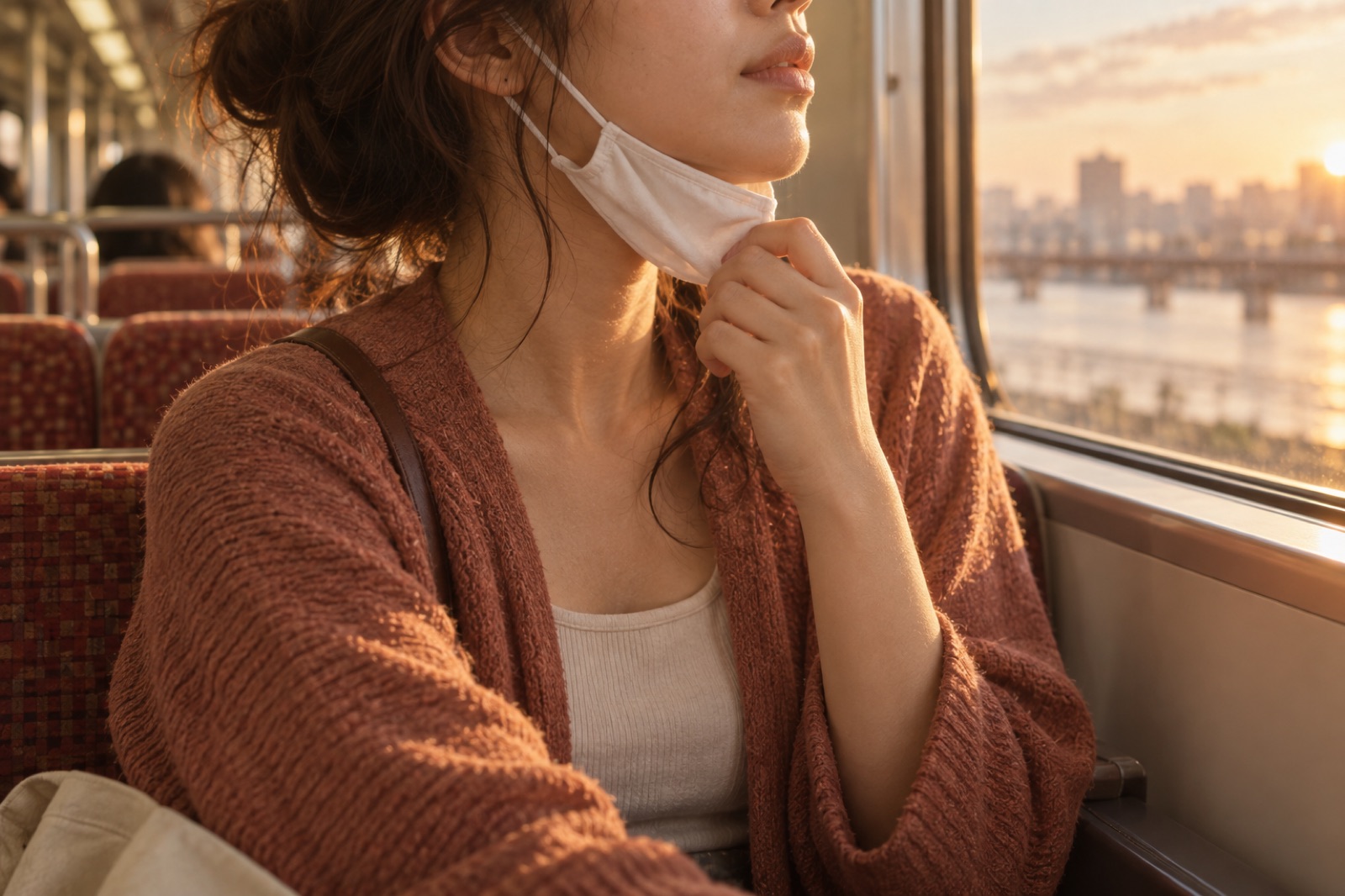
No study sets a swap interval, so build the schedule around cutting your daily wearing time even a little. The idea is to decide in the morning when you’ll briefly take it off somewhere private and when you’ll switch a damp mask for a fresh one.
A 2022 study that examined 101 doctors and nurses found acne in 55.4%, and being female, using N95 masks and daily wearing time came out as risk factors. A 2022 survey of 389 adults in Saudi Arabia also found significantly more skin damage the longer and more often masks were worn. If you’re a student with back-to-back classes, add a take-off-and-swap box at every break; if you wear one all day at a store or hospital, line it up with lunch and your afternoon break.
What order should you wash in after the mask comes off?
When you get home, three steps are enough: wash gently with lukewarm water, pat dry with a towel, then apply moisturizer. Hold off on rubbing hard at the cheeks and chin that were pressed all day, or adding an exfoliating scrub.
The KDCA acne guide says it is best to wash gently with lukewarm water twice a day and to remove makeup with a low-irritation cleanser and water. On days you wore sunscreen, wash in the same order, and rinse behind your ears and under your chin where the ear loops sat.
Is the bump on your cheek acne or an irritation reaction?
If redness, stinging or itching follows the outline of the mask edge, think irritation first; if tiny bumps or red bumps come up pore by pore, think acne first. The two often mix, so dated photos are the most reliable record.
In a 2022 survey of 2,326 people in Saudi Arabia, 44.4% had mask-related skin problems, the cheeks were the most common spot (46.8%), and redness, itching and acne were reported often. The KDCA explains that an irritation reaction can make the touched area red, cracked, oozing or sore. There are plenty of acne reports too, such as a 2021 survey in which 53.4% of 193 health workers in Pakistan had acne.
Schedule for a long mask day
| Time | What to do | Log box |
|---|---|---|
| 7:30 a.m. | Lukewarm face wash → one thin layer of moisturizer | Name of the product you applied |
| 8:00 a.m. | If you’ll be outdoors, sunscreen 20 to 30 minutes before heading out | Check if applied |
| 10:30 a.m. | Take it off briefly somewhere private and blot sweat and moisture with a tissue | Was the inside damp? |
| 12:30 p.m. | Switch to a fresh mask after lunch | Number of swaps |
| 3:00 p.m. | Short break; if you were outdoors, reapply sunscreen (every 2 to 3 hours) | Reapplied? |
| 6:30 p.m. | Home → lukewarm face wash → pat dry → moisturizer | Total hours worn today |
| 10:00 p.m. | One photo of cheeks and chin | Number of new bumps, redness or itching |
This table is not an interval set by research; it is an example of splitting up daily wearing time to reduce it. Follow it for 1 week, then compare total wearing hours and number of swaps on days breakouts went up, and adjust your own schedule.
When is it time to have a doctor check your mask area?
- If the mask area turns red and cracked, oozes or hurts, have a dermatologist check whether it is an irritation reaction.
- If cheek and chin breakouts stay the same or spread widely after cutting mask time and watching for 4 weeks, consider seeing a dermatologist.
- If tiny bumps grow into red, hard, painful bumps, don’t squeeze them; talk to a dermatologist.
- If only the spots touched by ear loops or the nose wire keep itching and turning red, have a doctor check whether you’re reacting to the material.
What this article is based on
- A 2022 study that examined 101 health workers found acne in 55.4%, with 58.9% of those cases new, and daily wearing time was a risk factor.
- A 2022 survey of 2,326 people in Saudi Arabia found that 44.4% had mask-related skin problems, with the cheeks most common at 46.8%.
- The Korean Dermatological Association advises applying sunscreen 20 to 30 minutes before outdoor activity and reapplying every 2 to 3 hours.
Frequently asked questions
Will breakouts from wearing a mask settle once I stop wearing it?
The evidence behind this article has no study that timed how long they take to settle. A 2022 study of 101 health workers found daily wearing time was a risk factor for acne, so log weeks when you cut back on mask time separately from weeks you didn't, and see a doctor if nothing changes or it spreads after 4 weeks.
Do I still need sunscreen if I'm wearing a mask?
If you'll spend time outdoors, start with the areas the mask leaves bare: forehead, around the eyes and upper cheeks. The Korean Dermatological Association advises applying 20 to 30 minutes before going outside and reapplying every 2 to 3 hours, so spread a thin layer where the mask sits and let it absorb before you put the mask on.
What should I do about tiny bumps from wearing a mask?
Don't squeeze them or scrub them; keep washing and moisturizing simple and count new ones. Korea's KDCA notes that scratching or squeezing acne yourself makes scars more likely. If the tiny bumps turn red and grow, or spread and itch, have a dermatologist check them.
How should I handle chin acne from wearing a mask?
The chin is where the lower edge of the mask rubs every time you talk, so the starting point is setting your swap times and short breaks. If it keeps coming back only on your chin, your cycle or shaving may also overlap with mask days, so log them on the same calendar.
Sources
- Occupational facial skin conditions from mask use in health care workers, 2022 (PMID 34450685)B
- Face mask use and skin damage: a cross-sectional survey in Saudi Arabia, 2022 (PMID 36532930)B
- Mask wearing and acne among health care workers during COVID-19, 2021 (PMID 34675578)B
- Mask-induced facial skin conditions in the Saudi population, 2022 (PMID 36483886)B
- Korea Disease Control and Prevention Agency (KDCA) National Health Information Portal — Irritant contact dermatitis (Korean)Institutional
- Korea Disease Control and Prevention Agency (KDCA) National Health Information Portal — Acne (Korean)Institutional
- Korean Dermatological Association — Sunscreens (Korean)Institutional
Videos and forum posts never count as evidence for a fact here. Full rules: Editorial policy
What to check when choosing a product for this routine
Check the criteria below before the product name. Each item can be found on the full ingredient list or in the product description.
| Item | What to look for | Why |
|---|---|---|
| Texture and amount | Whether the label names the texture (cream, lotion and so on) and how much to use each time | It makes it easier to set an amount that won't sit thick under a mask |
| Fragrance | Fragrance in the full ingredient list, or a no-added-fragrance label | Fewer ingredients touching a covered area means one less variable to log |
| Moisturizing ingredients | Whether moisturizing ingredients such as ceramides or hyaluronic acid appear in the full ingredient list | It gives you a basis for comparing the moisturizers you use after washing off a mask day |
| Testing disclosure | Whether the brand says how irritation was tested | Results vary by person, but it gives you one more point to compare products on |
Product from this site's operator · KW Cosmetic Content Team
Revive Therapy N.F CreamCosmetics do not replace the diagnosis or treatment of a skin condition.