Face Wash for Kids: A 2-Week Solo Washing Order and Log
Don't switch the face wash for kids you already use. For the first 2 weeks, a parent and child log the water temperature, the spots where rinsing is finished, and how the towel is used.
What this note covers9 sections
- Face wash for kids: what should a parent watch in the first 2 solo weeks?
- On a rushed school morning, what order should washing follow?
- After PE or swimming, how do you split washing between school and home?
- Washing the face in the evening shower: can foam cleanser go on the body too?
- How do you check the spots where rinsing is finished?
- If tiny bumps show up after something new, what goes in the log?
- The 2-week solo washing order and log
- When is it time to see a dermatologist? Signs to check together with your child
- Evidence summary for this guide
| Item | Detail | Basis |
|---|---|---|
| Situation: when the water is hot | Ten volunteers who soaked one forearm in a 40°C (104°F) detergent (SLS) solution and the other in a 20°C (68°F) one had significantly greater water loss (TEWL) on the 40°C side; another 10 who soaked only in water without detergent showed no significant change at either temperature | 1996 PMID 8869682 · A |
| Timing: the final rinse water | In repeated tests of 3 cleansers (soap and synthetic) with water of 0–11 grain hardness, the area washed with 11-grain water was drier and redder under the milder washing method, and the hardness of the rinse water mattered more than that of the wash water | 1996 PMID 9118628 · A |
| Count: a third wash in one day | In 25 volunteers washed three times a day for 4 days with an automated washing device, all 5 reference cleansers increased water loss and lowered stratum corneum hydration (a study of a test method for workplace cleansers) | 2014 PMID 24588368 · B |
| Log item: towel | Roughly rubbing away sweat from exercise with a towel can irritate the skin, so the advice is to gently pat it with a clean towel | AAD · Institution |
| Role: cleanser | Divides basic skincare into facial cleansers, toners, lotions and creams, and describes the facial cleanser’s role as removing sebum and sweat | Korean Dermatological Association · Institution |
Face wash for kids: what should a parent watch in the first 2 solo weeks?
With face wash for kids, keep the one your child already uses, and for the first 2 weeks a parent watches and logs only four conditions: water temperature, lather, the spots where rinsing is finished, and the towel. In week 1, the parent stands nearby and fills in the log; in week 2, the child fills in the boxes and the parent only adds a check mark each evening.
If you switch the cleanser at the same time, you can’t tell whether tightness or stinging comes from the conditions or from the product. The conditions the studies in the table above pointed to as raising cleansing irritation were also hot water, rinse water and washing again on the same day. Leave the moisturizer and sunscreen steps alone for these 2 weeks too. A 2023 Delphi consensus of 10 Asia-Pacific dermatologists (PMID 36409588) grouped cleansing into one package with moisturizer and sunscreen use, but it is a consensus about managing skin concerns such as acne and sensitive skin, not a source that looked at children’s face washing on its own.
On a rushed school morning, what order should washing follow?
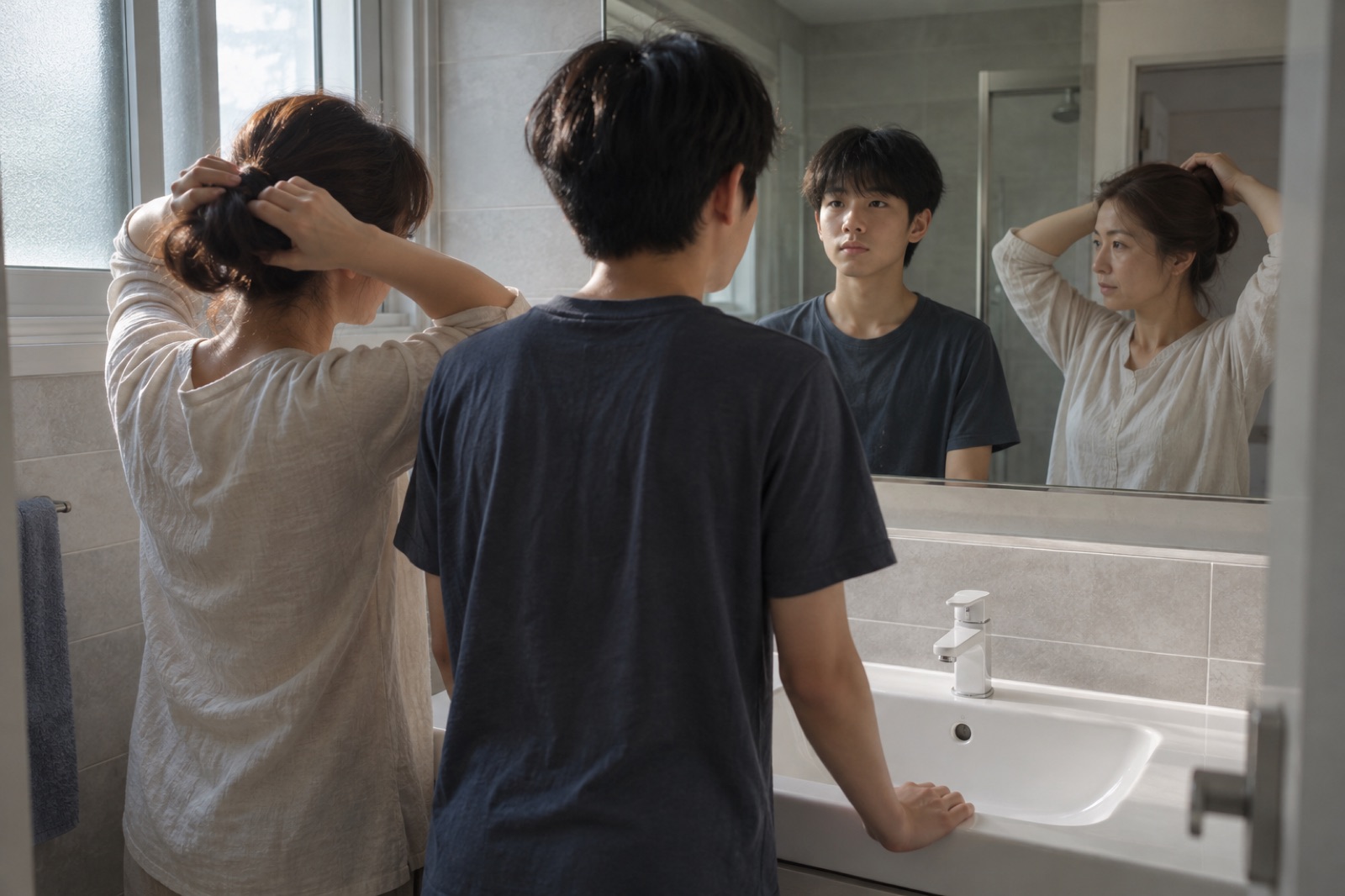
Start by pulling the hair back and tying it, make the lather in the palms first, check the rinse-finished spots in the mirror once, and then pat with a towel. The less time there is in the morning, the more easily rinsing at the hairline and under the chin gets skipped, so always check those two boxes.
In week 1, the parent watches for just two things: whether the child squeezes cleanser straight onto the face and rubs it in, and whether the towel gets swiped across the face. Say one thing in the moment, write the rest in the log, and look at it together in the evening.
After PE or swimming, how do you split washing between school and home?
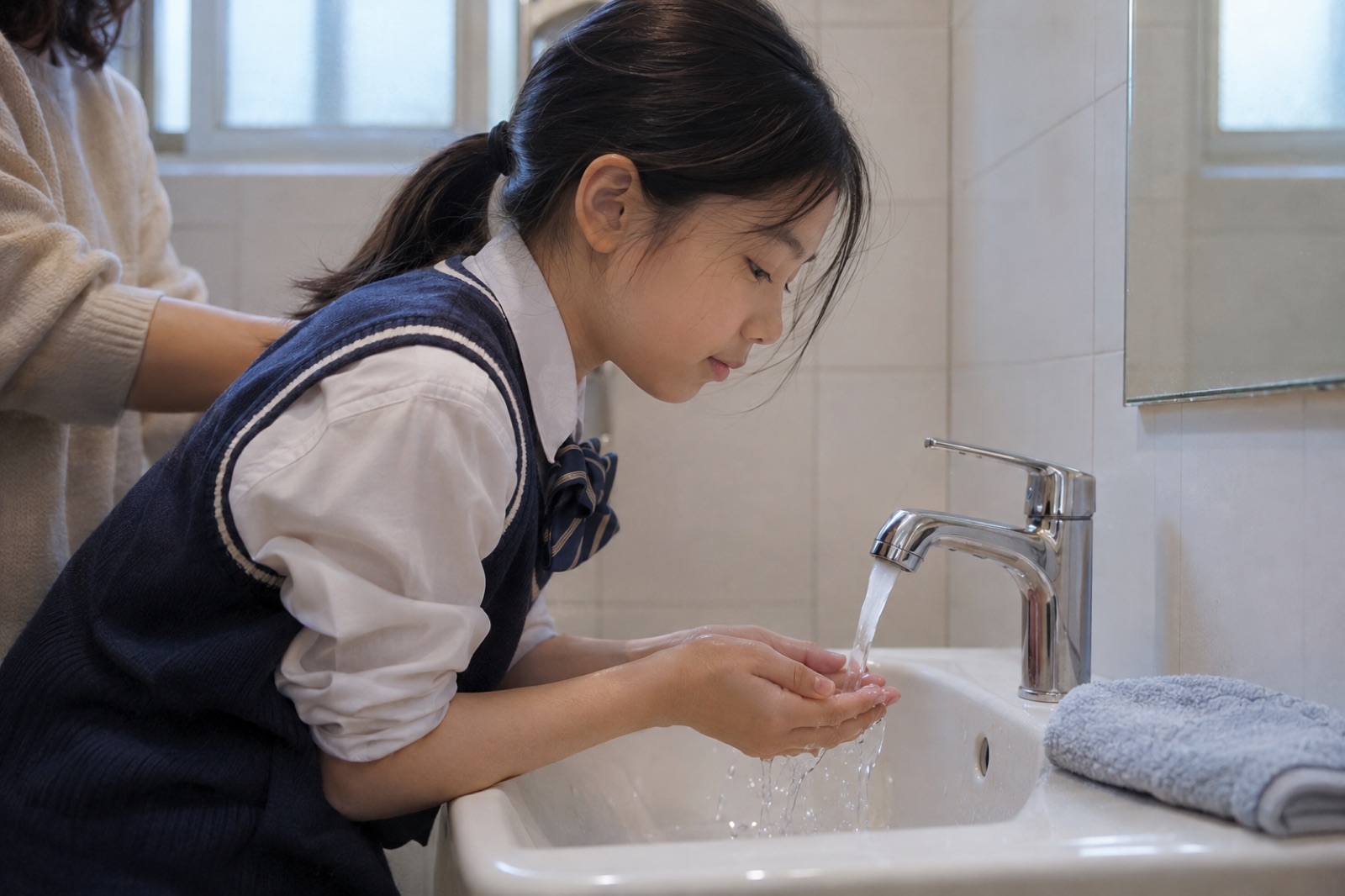
At school, rinse off sweat with water and no cleanser and pat dry with a personal towel; save the face wash for the evening wash at home. On days your child showers at the pool, write in the “what happened that day” box whether that shower took the place of the evening wash, so a third wash doesn’t end up happening that day.
The reason to cut down third washes through the log comes from a 2014 test (PMID 24588368). When 25 volunteers were washed three times a day for 4 days with an automated washing device, water loss rose with all 5 reference cleansers tested. Because it was a study building a test method for workplace cleansers, it can’t be carried over as is to face washes or to children’s skin, so this guide uses it only to find the situations where a third wash happens, not to set a number of washes. The American Academy of Dermatology (AAD) advises against roughly rubbing sweat away with a towel during exercise and suggests gently patting with a clean towel, so make the towel in the gym bag one that belongs to your child and isn’t swapped with friends.
Washing the face in the evening shower: can foam cleanser go on the body too?
The sources checked for this guide can’t settle whether it’s fine or not. But in the 2-week log, keeping the face cleanser and the body wash separate is what lets you read tightness after washing as one condition.
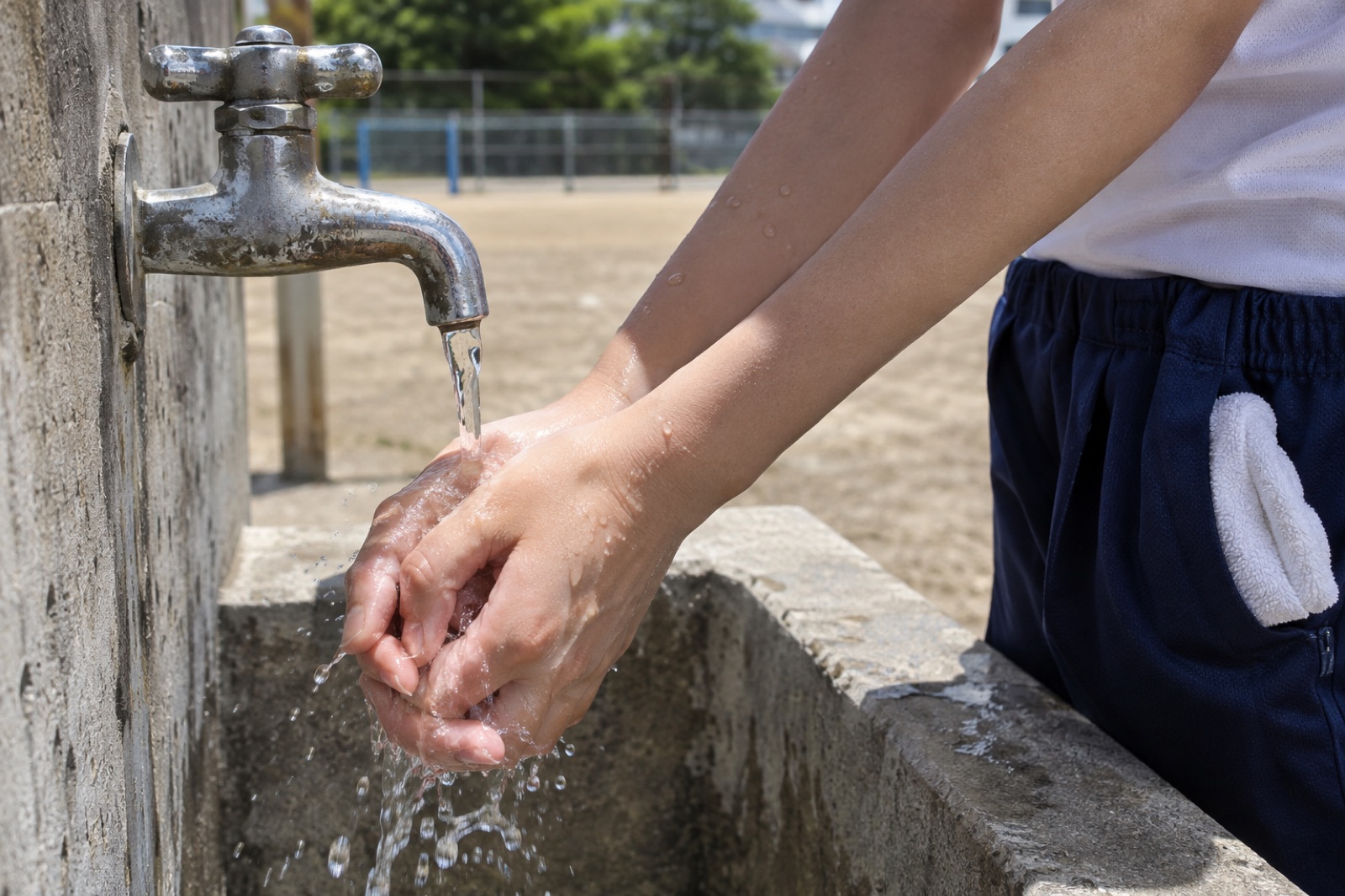
In the shower, washing the hair and body first and leaving the face for last keeps the log simple. Don’t use hot shower water straight on the face; when it’s the face’s turn, turn the water temperature down one step, and wet and rinse with water caught in the hands. In a 1996 randomized trial (PMID 8869682), forearms soaked in a 40°C (104°F) detergent solution lost significantly more water than those at 20°C (68°F), but the side soaked only in water without detergent showed no significant difference by temperature. Because that test soaked arms in a lab detergent (SLS) solution, don’t read it as a face-washing result; the log records only whether hot water was used on the face, as ○/×.
How do you check the spots where rinsing is finished?
After rinsing, stand at the mirror, touch three spots once each with a finger (the hairline, under the chin and in front of the ears) to see whether a slippery film is left, and check them off. Lather tends to run down and collect in these spots, and they are hard to see in a mirror straight on, so in week 1 the parent touches them for the child.
The clue for why rinse water gets its own box is in a 1996 repeated-washing test (PMID 9118628). In an experiment washing with 3 cleansers (soap and synthetic) in water of different hardness, the area washed with 11-grain water was drier and redder than the area washed with deionized (0-grain) water under the milder washing method, and what split the results more was the rinse water, not the wash water. It was an experiment with exaggerated washing conditions, and this guide doesn’t judge the hardness of your tap water at home, so log rinsing as “were the three spots rinsed all the way” rather than “what kind of water.”
If tiny bumps show up after something new, what goes in the log?
If tiny bumps or hive-like spots appear while using a foam cleanser, essence and lotion together, stop the most recently added one first, and from that day write the location and shape in the “reaction” box. The log alone can’t decide the cause; if it continues or spreads after stopping, have it checked at a visit.
This log is for watching washing conditions, so it assumes you don’t add any new products during the 2 weeks. If your child was already using several, write them all on the day 0 line, and note the date each time you stop one.
The 2-week solo washing order and log
| Scene | Order | What the parent watches in week 1 | What the child logs in week 2 |
|---|---|---|---|
| Before school | Tie hair back → wet face → lather in palms → rinse → touch three spots → pat with towel | Whether cleanser goes straight onto the face | Spots missed when rinsing |
| After PE or swimming | School: rinse with water → personal towel / Home: face wash at the evening wash | Whether a towel is shared | Whether that wash was the third of the day |
| Evening shower | Hair and body first → lower the water temperature → face washed separately with cleanser | Whether shower water goes straight onto the face | Hot water ○/× |
| Weekend evening after sunscreen | Wash once home → touch three spots → re-rinse only spots that are left | Spots where a slippery film is left | Mark sunscreen days |
| Day 7 evening | Count week 1 boxes → choose which boxes to hand to the child in week 2 | Items with many blanks | — |
| Day | When · what happened that day | Hot water | Rinse-finished spots (hairline · under chin · in front of ears) | Tightness · stinging 0–2 | Towel pat | Reaction (red spots · swelling · itching) | Who logged · check |
|---|---|---|---|---|---|---|---|
| Day 0 | Current order · what goes on after washing | Parent | |||||
| Day 1 (example) | Morning | × | ✓ ✓ □ | Tightness 1 · stinging 0 | ○ | None | Parent |
| Days 2–3 | Parent | ||||||
| Days 4–7 | Child · parent checks | ||||||
| Day 7 count | Third washes: _ | ○ _ | □ _ | Total _ | × _ | Days marked _ | Together |
| Days 8–13 | Child · together in the evening | ||||||
| Day 14 count | Third washes: _ | ○ _ | □ _ | Total _ | × _ | Days marked _ | Together |
On day 14, put the two count lines side by side and pick just one condition to change in week 3. If the □ in front of the ears hasn’t gone down, adjust the rinsing order first; if hot water ○ marks remain, adjust the shower order first.
When is it time to see a dermatologist? Signs to check together with your child
- If red spots, swelling or itching continue or spread for several days after you stop the newly added product, have a dermatologist take a look.
- If a painful bump that feels deep appears, breakouts multiply quickly over a few days, or spots start to leave marks, don’t wait to finish the log; see a dermatologist.
- If itching keeps your child from sleeping, or a scratched spot starts to ooze, get it checked at a visit.
- If your child is bothered enough to avoid mirrors or gym class, bring the 2-week log to a dermatologist and talk it over.
Evidence summary for this guide
- In a 1996 randomized trial looking at the forearms of 20 healthy volunteers (PMID 8869682), a 40°C detergent (SLS) solution significantly increased water loss (TEWL) compared with 20°C, and water without detergent showed no significant change regardless of temperature.
- In a 2014 test washing 25 volunteers three times a day for 4 days with an automated washing device (PMID 24588368), all 5 reference cleansers increased water loss and lowered stratum corneum hydration (a workplace cleanser test).
- In a 1996 study that repeatedly tested 3 cleansers with water of 0–11 grain hardness (PMID 9118628), the hardness of the rinse water had a larger effect on dryness and redness than that of the wash water.
Frequently asked questions
Is a low-pH body wash different from a face wash?
"Low pH" or "mildly acidic" is a label about a product's acidity; whether a product is meant for the face is shown by the use area and directions on the container. The sources checked for this guide include no study comparing body wash and face wash on children's faces. During the 2-week log, use only the usual face cleanser on the face and keep body wash below the neck, so tightness after washing can be read as one condition.
What happens if you don't wash off sunscreen?
No study in this guide's evidence measured what sunscreen left on the skin does, so we don't state an outcome. On an evening after sunscreen, write "sunscreen" in the "what happened that day" box, and after washing, touch the hairline, under the chin and in front of the ears to feel whether any slippery film is left. If a spot is left, rinse only that spot again and mark it □.
Does body wash remove sunscreen from your body?
This guide found no data measuring how well body wash takes off sunscreen applied to the body. On days sunscreen goes on the arms and neck, wash those areas with body wash in the evening shower, and wash the face separately with the face cleanser instead of carrying on with the same lather, so the log stays split. If the arms or neck sting or turn red after washing, note the spot in the reaction box.
White residue after washing your face: is it leftover sunscreen?
You can't tell by eye whether white residue is sunscreen or cleanser. In a 1996 repeated-washing experiment (PMID 9118628), the amount of soap left bound to the skin also tended to rise when harder water was used, but this study can't tell you your home's water hardness or what the residue is. Note the spot where you saw residue in the rinse box, and compare it with days you rinsed that spot once more.
Should your face feel squeaky clean or slippery after washing?
Don't decide whether the face is clean from a squeaky or slippery feel alone. The studies behind this guide measured markers such as water loss, dryness and redness, not how skin feels to the touch. In the log, record tightness and stinging after washing on a 0–2 scale instead of the feel, and check slipperiness only for whether it is still there when you touch the rinse-finished spots.
How do you know if your face is fully rinsed with no residue?
The check in this guide: after rinsing, stand at the mirror and touch the hairline, under the chin and in front of the ears once each with a finger to see whether a slippery film is left. Rinse any spot that is left again, mark it □, and on day 7 count which spots are most often left. This guide's evidence has no tool or cutoff number for measuring residue.
Does hot water open pores and cold water close them?
No source behind this guide measured whether water temperature opens or closes pores. What the 1996 trial (PMID 8869682) showed is that forearm water loss was greater with a detergent solution at 40°C (104°F) than at 20°C (68°F), while plain water without detergent caused no significant change at either temperature. For a child's face washing, the only rule here is not to put hot shower water straight on the face; this guide doesn't decide whether to finish with cold water.
Does my child really need a dermatologist, or is home care enough?
If there are painful bumps that feel deep, breakouts that multiply quickly over a few days, spots that are starting to leave marks, or red spots, swelling or itching that continue even after the newest product is stopped, don't wait; see a dermatologist. If your child is bothered enough to avoid mirrors or gym class, that is also a sign to consider a visit. Bringing the 2-week log as is makes it easier to explain what changed and when.
Sources
- Detergent solution temperature (20°C vs 40°C) and skin water loss, randomized forearm trial in 20 volunteers, 1996 (PMID 8869682)A
- Hardness of wash and rinse water and skin irritation from 3 cleansers, repeated washing test, 1996 (PMID 9118628)A
- Standard irritation test method for workplace skin cleansers, automated washing 3 times a day for 4 days, 25 people, 2014 (PMID 24588368)B
- Integrated cleansing, moisturizer and sunscreen care, Delphi consensus of 10 Asia-Pacific dermatologists, 2023 (PMID 36409588)A
- American Academy of Dermatology (AAD) — 10 skin care habits that can worsen acneInstitutional
- Korean Dermatological Association — Basic skincare cosmetics (Korean)Institutional
Videos and forum posts never count as evidence for a fact here. Full rules: Editorial policy
What to check when choosing a product for this routine
Check the criteria below before the product name. Each item can be found on the full ingredient list or in the product description.
| Item | What to look for | Why |
|---|---|---|
| Step on the label | Whether the directions say where it goes in the order, such as after cleansing and toner | The 'applied after washing' box in the log can hold one step name and stay on the same line for all 2 weeks |
| Fragrance, essential oils and ethanol | Whether a parent has read the full ingredient list for all three before starting | During 2 weeks of changing only the washing conditions, you don't add other variables that touch the skin |
| Dispensing container | Whether it has a dropper or pump that gives out a similar amount each time | Even on solo days, the amount is easy to write in the same box as a number of drops or pumps |
| Stop-use note | Whether it says not to use it if red spots, swelling or itching appear | On a day the reaction box gets a mark, you can match it straight to the label to decide what to pause |
| Areas to avoid | Whether it says not to apply it on skin that has not closed yet | It gives you a rule for leaving scratched spots out of the area you apply to that day |
Product from this site's operator · KW Cosmetic Content Team
Revive Therapy N.F AmpouleIn the 2-week log, the 'applied after washing' box is the moisturizing step after toner and before cream. The water temperature, rinse water and repeated washing studies cited here did not test this ampoule, and it has completed a human patch test (low-irritation test) but has no test data in children. Per its full ingredient list, it has no added fragrance, essential oils, ethanol, colorants or silicones, and it is a 30 ml dropper ampoule with betaine and panthenol. For keeping the moisturizing step fixed to one product while you change only the washing conditions for 2 weeks, the product we suggest is Revive Therapy N.F Ampoule.
Fitting it into a routine
Where it goes: After toner, before cream
How to use it: After toner, take a suitable amount with the dropper and spread it gently over the whole face or over the areas that need moisture. Pat lightly until absorbed, then finish with N.F Cream.
Check before you use it: If red spots, swelling, itching or any other unusual reaction appears during or after use, stop using it and consult a dermatologist. Avoid using it on areas with wounds, and do not read data on the PDRN raw material as equivalent to a medical procedure or to the efficacy of the finished product.
Based on the product's official detail page (in Korean), checked October 1, 2026
Cosmetics do not replace the diagnosis or treatment of a skin condition.