Cleansing Pads and Wipes: 2-Week Swipe and Redness Log
When you switch to cleansing pads or wipes, log four things every evening for the first 2 weeks: sheets used, passes over each spot, how hard you wiped, and how many minutes redness took to settle.
What this note covers9 sections
- Why log sheets and passes first when you switch to cleansing pads or wipes?
- How do you log sheets differently on a full-makeup night and a sunscreen-only night?
- What do you write down on a day your eye area or cheeks turn red after wiping?
- How do you split out days when the sheets dried out with the lid left open?
- How do you log patting versus rubbing with a towel after washing?
- On day 14, how do you compare week 1 with week 2?
- Your 2-week cleansing pad and wipe log
- When should redness after wiping send you to a dermatologist?
- Which studies and sources is this log built on?
| Focus | Finding | Source |
|---|---|---|
| Count: the rubbing motion | 6 healthy adults washed one forearm with soap plus nylon-towel friction twice a day for 14 days; compared with the soap-only arm, transepidermal water loss became larger, and natural moisturizing factor, serine and lactate became lower | 2018 PMID 29243811 · B |
| Tool: bare hands vs cotton towel | 19 people with a dry, itchy skin condition switched to an advised foaming cleanser and were compared side to side for 4 weeks; the items whose scores went down differed between the bare-hand side and the cotton-towel side | 2024 PMID 37915292 · B |
| Logging: reactions you notice yourself | In self-reports from 9 cross-sectional studies with 4,569 people, redness made up 27% and itching 19% of cosmetic-related adverse reactions, but the cross-sectional design can’t sort out the cause | 2025 PMID 40330400 · A |
| Timing: from contact to reaction | Common causes of skin reactions from irritants are soaps, detergents, solvents and regular contact with water; reactions show up within a few hours to days after contact and are most common on the hands and face | NHS · Institution |
| Pacing: adding one at a time | Surfactants, preservatives, colorants and artificial fragrances are named as cosmetic ingredients that can cause irritant reactions; when cosmetics are suspected of making skin sensitive, the advice is to stop all of them and, once symptoms are gone, add gentler cosmetics back one at a time, 1–2 weeks apart, and watch | Korean Dermatological Association · Korean institution |
Why log sheets and passes first when you switch to cleansing pads or wipes?
The simplest way to tell whether cleansing pads or wipes are turning your skin red is to log, every evening for the first 2 weeks, how many sheets you used, how many passes you made over the same spot (cheeks, forehead, eye area), how hard you wiped, and how long the redness took to settle, all on one line. Whether the pad doesn’t suit you or you’re simply making too many passes is something these boxes sort out better than a feeling.
The pads in this guide are the cleansing step that takes off makeup and sunscreen. Set the way you finish after wiping by the directions on the container and keep it fixed for the full 2 weeks; this guide logs only the wiping conditions.
Passes get their own box because the rubbing motion itself leaves traces on the skin’s outer layer. In a 2018 forearm experiment, 6 healthy adults washed twice a day for 14 days with nylon-towel friction added on one arm only. Compared with the other arm, washed with soap alone, more water escaped from the skin, and the outer layer held less natural moisturizing factor, serine and lactate. Because it was a small experiment on arms with a towel, its numbers aren’t carried over to facial sheets; it serves only as the reason to keep passes in a separate box.
If all you note is “it doesn’t agree with me,” the cause gets blurry. In a 2025 review pooling 9 cross-sectional studies with 4,569 people, redness and itching were commonly reported, and how often and how long people used products moved along with them, but because every answer was a self-reported survey, the review couldn’t say what caused what. That’s why you log “how many sheets, how many passes, how hard,” with the date.
How do you log sheets differently on a full-makeup night and a sunscreen-only night?
When what you took off changes, so does the sheet count, so write what you took off that day (sunscreen only, base makeup or full makeup) before the sheet box. A day with more sheets isn’t a bad day; record what you took off and the sheet count as a pair.
On evenings you take off full makeup, like after a Saturday wedding you attended as a guest or a Friday work dinner that ran late, it’s easy to go through 2–3 sheets. On those days, passes per spot matter more than the sheet count. Write down as numbers, spot by spot, how many passes you made over an eye area still holding mascara and over cheeks with thick foundation, and later you can match up whether redness shows up first around the eyes or on the cheeks. The order for taking off full makeup itself is covered in the routine for a day you wear makeup over breakouts.
If a work-from-home day with sunscreen only ended with 1 sheet, just write “1 sheet.” The redness box on low-count days becomes the baseline you compare full-makeup days against.
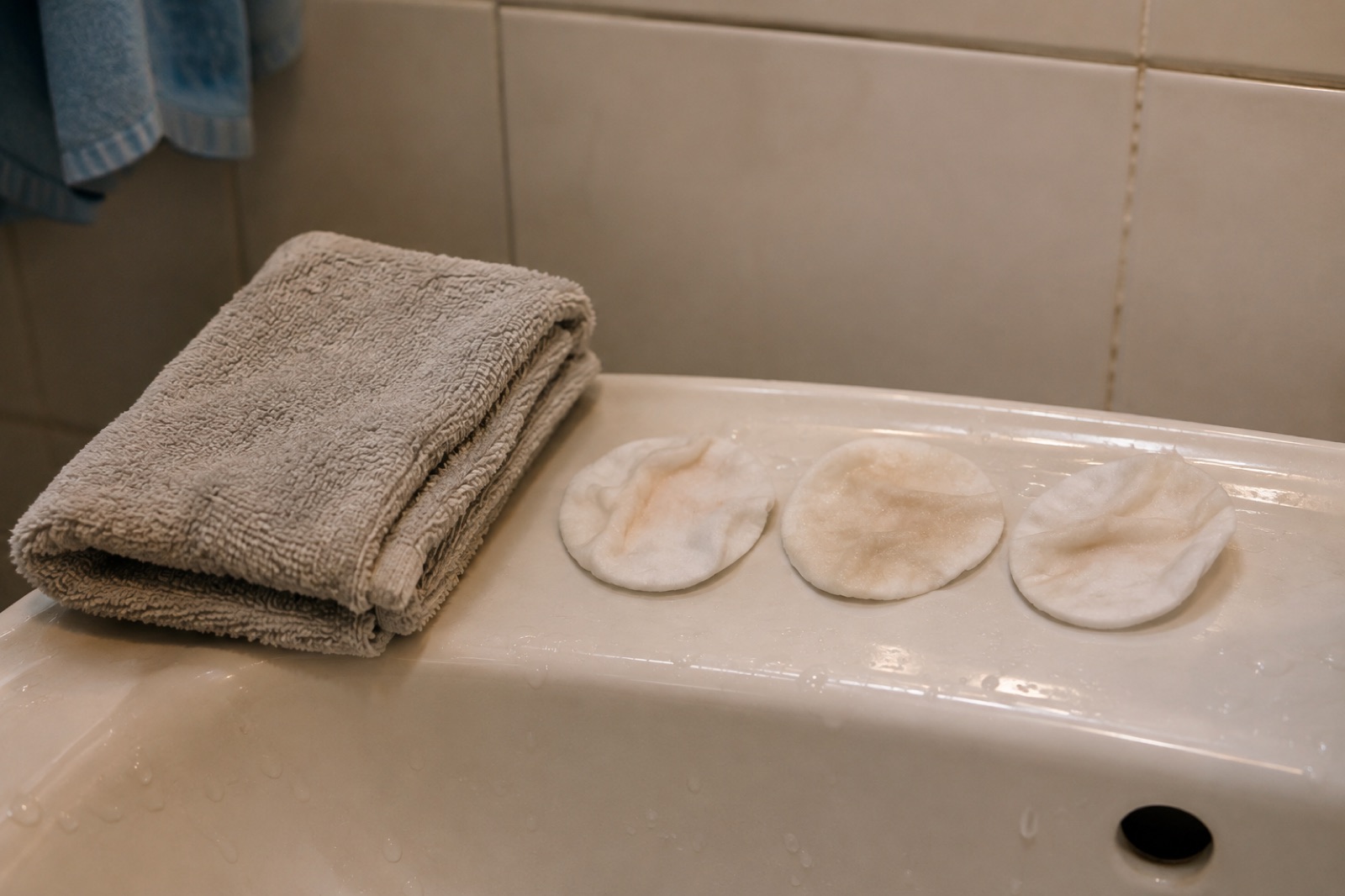
What do you write down on a day your eye area or cheeks turn red after wiping?
For each spot you wiped, score redness and stinging from 0 to 2, and write down in minutes how long the redness took to settle. Look in the same mirror under the same light, once right after wiping and once about 10 minutes later.
The scores are this guide’s editorial standard. A 0 means nothing changed, 1 means faint redness only inside the wiped area, and 2 means it spreads beyond the wiped area or comes with stinging. You don’t need a clock for the settling time; rough entries like “right away,” “within 10 min” or “over 30 min” are enough to compare with week 2.
There’s a reason to watch the reaction right after wiping, minute by minute. The Korean Dermatological Association, a professional society in Korea, lists irritant reactions among the types of cosmetic adverse reactions, and separately describes a reaction in which hives and redness appear within 30–60 minutes after contact with a specific substance. If the redness puffs up and itches, stop using that sheet before you record a score.
How do you split out days when the sheets dried out with the lid left open?
In the sheet condition box, mark “wet” or “dry,” and look at the passes on dry days separately. A dry sheet picks up less makeup, so it’s easy to go over the same spot more often; the sheet count may be the same, but the passes go up.
These are evenings like a winter day you left for work without closing the lid all the way in a heated room, or a night you used single-pack sheets that had sat for days in a pouch in your business-trip bag. If the redness box went up on dry days, start by logging whether you closed the lid before you switch pads. If redness is the same on dry and wet days, cross sheet condition off the list of possible causes.
How do you log patting versus rubbing with a towel after washing?
In the towel box, mark either pat or rub, and on days you didn’t use one, write “none.” This log is meant to look at wiping conditions, and if the towel changes too, it gets hard to tell where that day’s redness came from.
There is data showing results can shift when the washing tool changes. In a 2024 side-by-side trial, 19 people with a dry, itchy skin condition switched to an advised foaming cleanser, then for 4 weeks washed one arm with bare hands and the other with a cotton towel. A drop in the redness score was listed in the bare-hand results, while the cotton-towel results included a scratch-mark score. Because it was nonrandomized and looked at patients’ arms, it isn’t carried straight over to the face, but it’s reason enough to keep the towel as a separate variable.
On day 14, how do you compare week 1 with week 2?
On day 7 and day 14, write the totals for sheets and passes next to the redness total, and set the two weeks one line each. Circle the boxes the higher-redness days had in common (full makeup, dry sheet, pressure 2, rubbing towel).
If the circles cluster in one box, change only that one condition in week 3 and keep filling in the same log. Just as the Korean Dermatological Association advises, when cosmetics are suspected of making skin sensitive, stopping them all and, once symptoms are gone, adding them back one at a time, 1–2 weeks apart, changing one thing at a time keeps the possible causes from mixing in the next 2 weeks too. If you also plan to switch your face wash, continue with the 2-week check after changing your foam cleanser.

Your 2-week cleansing pad and wipe log
The first three rows of the table below show how to fill in the boxes. The scores (0–2) and the box layout are this guide’s editorial standard, not something studies compared.
| Date | What you took off | Sheets | Passes over the same spot (cheeks · forehead · eye area) | Wiping pressure 0–2 | Sheet condition | Redness/stinging after wiping 0–2 | Time to settle (min) | Towel (pat/rub) | Unusual reaction |
|---|---|---|---|---|---|---|---|---|---|
| e.g. Day 1 (Fri) | Full makeup | 3 | Cheeks 4 · forehead 2 · eye area 3 | 1 | Wet | Eye area 1 | Within 10 min | Pat | None |
| e.g. Day 3 (Sun) | Sunscreen only | 1 | Cheeks 2 · forehead 1 · eye area 0 | 0 | Wet | 0 | — | Pat | None |
| e.g. Day 5 (Tue) | Base makeup | 2 | Cheeks 5 · forehead 3 · eye area 2 | 2 | Dry | Cheeks 2 | Over 30 min | Rub | Stinging |
| Day 7 total | — | No. of dry days | No. of rub days | ||||||
| Day 14 total | — | No. of dry days | No. of rub days |
Below the table, write one line each for “how you finish (per the container directions)” and “what you applied after wiping,” and leave them unchanged for 2 weeks. If something hard to capture as a score shows up in the unusual-reaction box, such as swelling, a rash or hives, mark it that day and read the signs for seeing a doctor below before you fill in the next box. The steps for trying a new cosmetic on the inner arm first are laid out separately in the 7-day new product test for sensitive skin.
When should redness after wiping send you to a dermatologist?
- If the redness box stays at 1–2 for the whole 2 weeks even after you lower the pressure to 0–1 and cut down on passes, take your log and see a dermatologist.
- If a red rash or swelling spreads beyond the wiped area within a few hours to days after contact, stop what you were using and consider seeing a doctor. The NHS advises seeing a doctor if this kind of reaction persists, keeps coming back or is severe.
- If itchy, raised hives appear after wiping, or your eye area swells so that it’s hard to open your eyes, don’t wait for the log; see a doctor right away.
- If itching or pain continues even after you stop what you were using, have a dermatologist check it. The KDCA also advises stopping use and seeing a dermatologist if an unusual reaction appears.
Which studies and sources is this log built on?
- In a 2018 forearm friction experiment (PMID 29243811), 6 healthy adults added nylon-towel friction on one arm only, twice a day for 14 days; compared with the soap-only arm, transepidermal water loss became larger, and natural moisturizing factor, serine and lactate became lower.
- In a 2024 side-by-side trial (PMID 37915292, 19 people, nonrandomized), after switching to an advised foaming cleanser, the items whose scores went down meaningfully over 4 weeks differed between the bare-hand side (redness, dryness, itching) and the cotton-towel side (dryness, itching, scratch marks).
- A 2025 systematic review (PMID 40330400) tallied redness at 27% and itching at 19% in self-reports from 9 cross-sectional studies with 4,569 people; frequency and duration of use were linked, but the review notes that the cross-sectional design doesn’t allow conclusions about cause.
Frequently asked questions
Do you stack 4 cotton pads and wipe once, or use 1 pad at a time 4 times?
The evidence behind this guide has no study comparing stacked pads with switching to a fresh pad each time. Either way, log the sheet count and the passes over the same spot separately: on a stacked day, write '4 sheets · cheeks, so many passes,' and on a one-at-a-time day, '4 sheets · passes per spot.' For the first 2 weeks, log the way you already do it, then switch to the other way in week 3 and keep filling in the same boxes, and your log will show which way the redness box runs lower.
My skin is thin and gets red easily, so I can't use cotton pads. How do I cleanse thoroughly?
This log starts from not making up for thoroughness with pressure or extra passes. In the survey from a 2024 side-by-side trial (19 people), how much lather formed differed by washing tool, and in the trial itself, the scores that went down also differed between the bare-hand side and the cotton-towel side. If cotton pads feel like too much, keep the pressure box at 0–1, log redness and the minutes it took to settle, and finish the way the directions on your product's container say. If redness lingers every time you wipe, consider seeing a dermatologist and bring your log.
My face turns red after I finish cleansing. Is it from rubbing too hard?
One impression can't tell you whether it's pressure, so log wiping pressure (0–2) and redness after wiping (0–2) on the same line for 2 weeks. If redness only goes up on pressure-2 days, pressure becomes a candidate; if it's the same on 0–1 days too, look at other boxes, such as the liquid in the sheet, the water or the towel. In a 2018 forearm experiment (6 people), the side with added towel friction lost more water, but because that was seen on arms, it isn't carried straight over to facial pads.
If I wipe with cleansing water and then wipe again with a wet cotton pad, is that more irritating?
The evidence this guide drew on has no study measuring what a second pad adds on its own. The UK's National Health Service (NHS) lists regular contact with water, along with soaps and detergents, among the common causes of skin reactions from irritants, so count the second pad's passes in your same-spot passes too. Keep the way you finish the same for the 2 weeks, and just watch whether the redness box changes on days you used a second pad.
My skin is very thin and sensitive. Is it OK to wipe it with cotton pads?
Rather than deciding yes or no in advance, give thin areas like the eye area their own box for the first 2 weeks and log passes and redness there. The Korean Dermatological Association names surfactants, preservatives, colorants and artificial fragrances as four groups of cosmetic ingredients that can cause irritant reactions, and some of these may be listed in a pad liquid's full ingredients, so don't add any other new product within the same 2 weeks. When cosmetics are suspected of making skin sensitive, the association advises stopping them all and, once symptoms are gone, adding them back one at a time, 1–2 weeks apart. Once redness has settled and you bring in something new, use that interval as your logging cycle.
Can I skip drying my face with a towel after washing and just leave it wet?
The evidence this guide drew on has no study comparing towel-drying the face with leaving the water on. The 2024 trial that split washing tools into bare hands and a cotton towel didn't look at drying either; it only goes as far as showing that the scores that went down differed between the two sides. Add 'none' to the towel box alongside pat and rub, and look at that day's redness and minutes to settle side by side.
After changing how I wipe, my breakouts keep coming and going. How do I tell what's behind it?
Memory alone makes the cause hard to pin down. A 2025 review pooling 9 cross-sectional studies with 4,569 people also found that how often and how long products were used was linked to adverse reactions, but because the answers came from self-reported surveys, it couldn't establish the cause. Log sheets, passes, pressure and sheet condition for each date, and on day 14, line up the days things got worse and the days they got better to see which boxes differed.
My skin flared up after switching to pads. Should I keep using them or stop?
Stop. In its guide on safe cosmetic use for teenagers, the Korea Disease Control and Prevention Agency (KDCA) says to stop using a product right away and see a dermatologist if an unusual reaction such as a rash, itching, pain, swelling or redness appears. If you bring the date you stopped, your log up to that point and the pads or wipes you were using, you can briefly explain to the dermatologist since when and where the reaction showed up.
Sources
- Repeated nylon-towel friction washing and reduced stratum corneum serine and lactate, forearm left-right comparison in 6 healthy adults, 2018 (PMID 29243811)B
- Switching to an advised washing method and foaming cleanser, bare hands vs cotton towel left-right comparison, 19-person nonrandomized trial, 2024 (PMID 37915292)B
- Adverse reactions to cosmetics and skincare products, systematic review of 9 cross-sectional studies with 4,569 people, 2025 (PMID 40330400)A
- NHS — Contact dermatitis (Overview)Institutional
- Korean Dermatological Association — Cosmetics overview and adverse reactions (Korean)Institutional
- Korea Disease Control and Prevention Agency (KDCA) National Health Information Portal — Safe cosmetic use for teenagers (Korean)Institutional
Videos and forum posts never count as evidence for a fact here. Full rules: Editorial policy
What to check when choosing a product for this routine
Check the criteria below before the product name. Each item can be found on the full ingredient list or in the product description.
| Item | What to look for | Why |
|---|---|---|
| Fragrance in the full ingredient list | Whether fragrance appears in the full ingredient list, and if the label says fragrance-free, what that statement is based on | Even on an evening your skin turned red after wiping, the last thing you put on carries one less unknown, so the redness box can be weighed against the wiping conditions alone |
| Routine position on the label | Whether the directions list it as the last step of the routine | The 'applied after wiping' line under your log can stay the same single line for all 14 days |
| Stop-use wording | Whether it says to stop using it if red spots, swelling or itching appear during use | You can use the same words in the log's unusual-reaction box as the ones printed on the container |
| Where not to apply it | Whether the pre-use notes say to avoid areas that have not healed yet | On an evening when wiping left a scuffed spot, you can decide right away to leave that spot out when you apply it |
| Checking the container you have now | Whether it tells you to recheck the full ingredient list and expiry date on the latest packaging | While you work through one jar over the two weeks, you can confirm it wasn't swapped for a different one partway through |
Product from this site's operator · KW Cosmetic Content Team
Revive Therapy N.F CreamThe 'applied after wiping' line at the bottom of the log is the slot you keep tied to one cream throughout. This cream was not used in the friction, washing-tool or reaction studies cited here, and no data looked at redness after wiping as a measure. It is applied as the last step of the routine after ampoule, has no added fragrance going by its full ingredient list, and has completed a low-irritation skin patch test. To keep the last step of your routine fixed to one product while you change only how you wipe, the product we suggest is Revive Therapy N.F Cream.
Fitting it into a routine
Where it goes: After ampoule, the last step of the routine
How to use it: After toner and ampoule, take a suitable amount and spread it gently from the center of the face outward. On areas where dryness bothers you, layer a small amount once more to finish.
Check before you use it: If red spots, swelling, itching or any other unusual reaction appears during or after use, stop using it and consult a dermatologist. Avoid using it on areas with wounds, and check the full ingredient list and expiry date on the latest packaging first.
Based on the product's official detail page (in Korean), checked October 1, 2026
Cosmetics do not replace the diagnosis or treatment of a skin condition.