How to Layer Hyaluronic Acid: How Many Coats for a Dry Room
No study has compared numbers of ampoule coats, so start with one coat. On days a heater or AC dries out the room, add a little more cream instead of stacking more ampoule.
What this note covers8 sections
- How many coats of hyaluronic acid ampoule should you apply?
- Under what conditions were the applied hyaluronic acid studies done?
- Why does your face get warm when you layer a hydrating ampoule?
- How should you change the amount when the heater or AC is on?
- Is hyaluronic acid you take by mouth backed by the same evidence as an ampoule?
- Weekly rotation chart for a hyaluronic acid ampoule
- When should you have a doctor look at your skin?
- The research behind this page, briefly
| Point | Detail | Source |
|---|---|---|
| Where an ampoule fits | Classed as a special-care step you add when cleanser, toner, lotion, and cream are not enough | Korean Dermatological Association · institution |
| Number of coats | We found no study comparing one coat with several. Start with one and decide from your log | Evidence gap · editorial standard |
| Heated indoor room in winter | After 6 hours in a room at 23.05% humidity, water loss from the arm with no cream rose by 26.70% | 2023 PMID 37357654 · A |
| Conditions of the applied-product study | A split-face comparison of a single 0.1% lotion used for 8 weeks included 21 people | 2023 PMID 35587723 · A |
| Using it with other ampoules | In 44 people using retinol 0.5% and vitamin C 30% together, dryness went up at weeks 4 and 8 | 2016 PMID 27050703 · B |
How many coats of hyaluronic acid ampoule should you apply?
We found no study that put one coat side by side with three, so the practical move is to start with one coat and check tightness two hours later before adding more. Before you add coats, check whether you sealed it with cream.
The Korean Dermatological Association, a Korean medical society, describes essences (serums) as products that concentrate moisturizing and skin-protecting ingredients, and groups them as a special-care step for when cleanser, toner, lotion, and cream are not enough. Stacking more coats does not change what that step is. If your cheeks feel tight at your desk around 3 p.m., try one coat followed by a thin layer of cream before you try patting on the ampoule three times in the morning.
Under what conditions were the applied hyaluronic acid studies done?
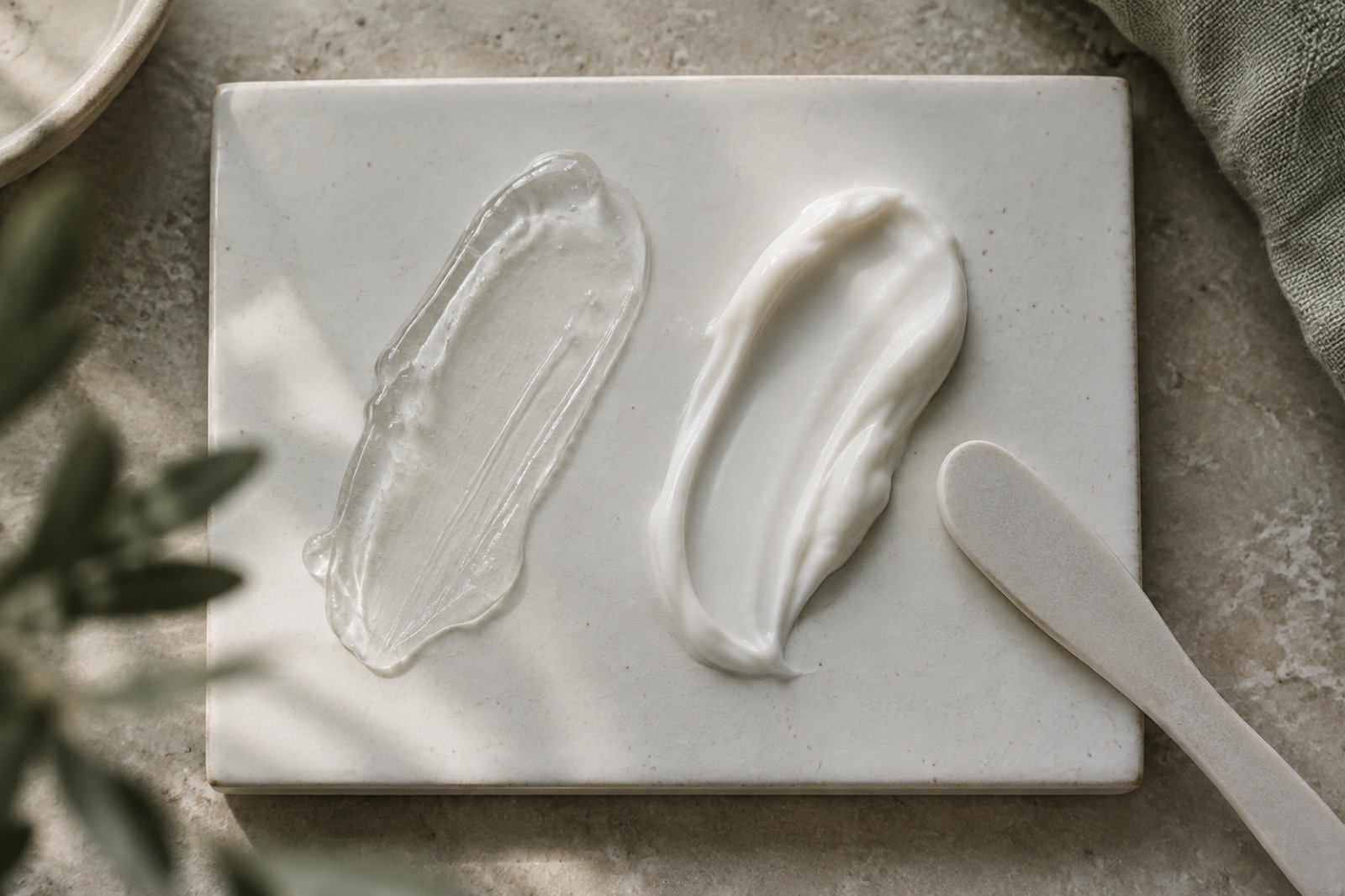
Most of these studies had people apply one product at a set strength for a set period, so their results don’t carry over to stacking several coats.
In a 2023 split-face trial, 21 people applied a single 0.1% low-molecular-weight (2 kDa) hyaluronic acid lotion to one side of the face for 8 weeks, and the study was linked to the ingredient maker. The authors wrote that no adverse reactions were seen during that period. In a 2014 trial, 40 women used one brand’s five-step set containing six molecular weights of hyaluronic acid for 30 days, so it can’t stand in for a single ingredient or for the number of coats. Both studies measured things other than tightness or moisture, so this guide borrows only their conditions, such as duration, strength, and how often it was applied, and not their result figures.
Why does your face get warm when you layer a hydrating ampoule?
No study has looked directly at why layering brings on a warm feeling, so it is hard to blame one ingredient. Write down which coat the warmth started on and how many minutes after applying, and you will see where to cut back.
Besides hyaluronic acid, an ampoule contains other ingredients such as preservatives and fragrance, and patting it in again and again adds another variable. Separate reports that low-molecular-weight hyaluronic acid can trigger inflammatory responses are debated, so we don’t assume it is gentle for everyone. If it still burns after you drop to one coat, take a break from that product.
How should you change the amount when the heater or AC is on?
On days the room is dry, focusing on the final cream step is closer to the evidence than adding ampoule coats. In a study that recreated a Korean winter indoor setting, the side that got cream dried out less.
In a 2023 Seoul study (23.05% humidity, 6 hours), water loss from the arm with no cream rose by 22.40% at 1 hour and 26.70% at 6 hours, while water content in the arm with cream rose by 81.81% at 1 hour and 73.02% at 6 hours. That cream was a mixed product with ceramides, glycerin, and other ingredients, so this is not a hyaluronic acid result. A 2016 literature review on humidity and skin summarized a study in which a humidifying mist raised water in the outer skin layer, but it also noted that the overall findings were mixed. Mark days when the air gets dry, like a dorm space heater or office air conditioning, in a separate column of your log.
Is hyaluronic acid you take by mouth backed by the same evidence as an ampoule?
No. Oral supplement studies work through a different route than an ampoule you apply, so results from one don’t carry over to the other.
A 2022 meta-analysis pooling 66 randomized trials with 4,090 healthy adults found that oral hyaluronan had a significant positive effect on skin hydration, but data on water loss were lacking.
Weekly rotation chart for a hyaluronic acid ampoule
| Day | Morning | Evening | Room condition | Afternoon tightness (0–3) | Warmth after applying |
|---|---|---|---|---|---|
| Mon | Vitamin C ampoule → cream → sunscreen | Hyaluronic acid 1 coat → cream | Mark heater, AC, humidifier | Yes/No | |
| Tue | Hyaluronic acid 1 coat → cream → sunscreen | Retinol → cream | |||
| Wed | Vitamin C ampoule → cream → sunscreen | Hyaluronic acid 1 coat → cream | |||
| Thu | Hyaluronic acid 1 coat → cream → sunscreen | Retinol → cream | |||
| Fri | Vitamin C ampoule → cream → sunscreen | Hyaluronic acid 1 coat → cream | |||
| Weekend | Hyaluronic acid 1 coat → cream → sunscreen | Hyaluronic acid 1 coat → cream (thicker if dry) | Total |
If you don’t use vitamin C or retinol yet, fill those cells with one coat of hyaluronic acid. Add only one new ampoule at a time, and if your tightness score is 2 or higher for more than three days, raise the amount of cream before you add coats.
When should you have a doctor look at your skin?
- If the area where you applied it still turns red and hot, or itching lasts more than three days after you cut back to one coat, stop using it and see a dermatologist.
- If your face swells, oozes, or a rash spreads down to your neck, get medical care right away.
- If you just had a procedure such as a laser or a peel, check with the clinic that did it before adding an ampoule.
- If your skin keeps flaking, cracking, and stinging even with cream, have a dermatologist check it.
The research behind this page, briefly
- In a 2023 study of 6 hours in a Korean winter indoor room at 23.05% humidity (PMID 37357654, 20 people for the face and 12 for the arm), water loss from the arm with no cream rose by 26.70%, and water content in the arm with cream rose by 73.02%.
- In a 2023 split-face trial (PMID 35587723), 21 people applied a single 0.1% 2 kDa hyaluronic acid lotion for 8 weeks, and no adverse reactions were reported during that period.
- In a 2016 trial (PMID 27050703, 44 women) using retinol 0.5% and vitamin C 30% together for 12 weeks, dryness rose at weeks 4 and 8 and did not continue at week 12.
Frequently asked questions
What order do you apply hyaluronic acid, vitamin C, and retinol?
We found no study in the evidence behind this guide that compared application order for these three ampoules. So we suggest using one at a time. Put vitamin C in the morning and retinol in the evening, and split the days too, so you can tell which day stung. Keep the hyaluronic acid ampoule as your base step in the routine (morning or evening) where neither of the other two is used.
Why does my face feel hot after layering a hydrating serum several times?
No study has looked directly at why layering causes a warm feeling, so it is hard to name one cause. Ampoules also contain other ingredients such as preservatives and fragrance, and patting the skin over and over is another variable. If the burning feeling keeps going after you cut back to one coat, stop that product, and if your skin swells or the redness spreads, see a dermatologist.
Can you mix or layer two ampoules at once?
We found no study that tested mixing two ampoules in the palm. When you mix them, you can't tell how much of each you applied, so if a reaction shows up, the cause is hard to pin down. Even when layering, add any new ampoule one at a time, with at least a week between each one.
Sources
- Korean Dermatological Association — Basic skincare products (Korean)Institutional
- 0.1% 2-kDa hyaluronic acid lotion, 8-week split-face comparison, 21 participants, 2023 (PMID 35587723)A
- Five-step cosmetic set with six molecular weights of hyaluronic acid, randomized trial in 40 women, 2014 (PMID 25399620)A
- Six hours in a low-humidity Korean winter indoor setting and a split-site moisturizing cream comparison, 2023 (PMID 37357654)A
- Oral supplements and skin hydration, meta-analysis of 66 RCTs with 4,090 participants, 2022 (PMID 35719159)A
- Retinol 0.5% plus vitamin C 30% used together, 12-week trial in 44 women, 2016 (PMID 27050703)B
- Ambient humidity and the skin, literature review, 2016 (PMID 27306376)C
Videos and forum posts never count as evidence for a fact here. Full rules: Editorial policy
What to check when choosing a product for this routine
Check the criteria below before the product name. Each item can be found on the full ingredient list or in the product description.
| Item | What to look for | Why |
|---|---|---|
| Hyaluronic acid on the label | Whether sodium hyaluronate or another hyaluronic acid form appears in the ingredient list, and how far up | If your ampoule and cream share the same family of ingredients, it is easier to decide whether one ampoule coat is enough |
| Texture | Whether it is a cream, gel cream, or lotion, and how much the label says to use at a time | It helps you decide how thick the last layer should be on days the heater or AC runs |
| Fragrance | Whether fragrance (parfum) is listed in the ingredients | If your face feels warm after layering, you have one less possible cause to rule out |
| Irritation testing | Whether the brand says how irritation was tested | Results differ from person to person, but it gives you one more point to compare products |
Product from this site's operator · KW Cosmetic Content Team
Revive Therapy N.F CreamCosmetics do not replace the diagnosis or treatment of a skin condition.