How to Improve Skin Texture: A No-Rubbing 2-Week Log
How to improve skin texture, as tested in this guide: stop rubbing your face for 2 weeks, and log the minutes from washing to moisturizer and how rough the skin feels, morning and evening.
What this note covers9 sections
- How to improve skin texture: why stop rubbing first, for 2 weeks?
- On a morning when skin feels rough and makeup looks patchy, what do you log?
- After a workout and shower, when hot water reached your face too, how do you log that evening?
- Why log the time on days moisturizer comes late after washing?
- On a weekend when you want to pull out a scrub or peel pad, what do you do instead?
- The 2-week skin texture log
- On day 14, what do you compare between week 1 and week 2?
- When should you ask a dermatologist about rough, irritated skin?
- The research behind this log, briefly
| Item | Detail | Basis |
|---|---|---|
| Timing: after one application | In 26 healthy volunteers, a glycerin-based cream was applied at random to six sites on the inner forearm; measured by Raman spectroscopy, hydration readings where it was applied differed significantly from bare sites (measured after a single application) | 2006 PMID 16679823 · A |
| Duration: 6 hours after applying | In a test that applied 4 moisturizing products to the arms and legs and measured for up to 6 hours, stratum corneum hydration ranked differently by product (largest rise 45.9→75.3, while the smallest, at p=0.738, was not significant), and water loss (TEWL) showed no significant difference from bare sites for any product | 2010 PMID 20394488 · A |
| Frequency: 3 times a day for 4 weeks | When healthy volunteers applied a moisturizer to one forearm only, 3 times a day for 4 weeks, hydration readings rose, but when that skin was then challenged with SLS, water loss on that arm was significantly higher than on the other arm | 1999 PMID 10086859 · A |
| Situation: washing three times in a day | Water loss (TEWL) went up and stratum corneum hydration went down with every one of the 5 reference cleansers — 25 volunteers, automated washing 3 times a day for 4 days, a test method for workplace cleansers | 2014 PMID 24588368 · B |
| Log item: towel and dryness | Rubbing sweat away roughly with a towel can irritate the skin, so pat gently with a clean towel instead; dry skin counts as irritated skin | AAD · Institution |
How to improve skin texture: why stop rubbing first, for 2 weeks?
How to improve skin texture, in its simplest at-home test, comes down to stopping the rubbing you did with scrubs, face brushes and towels for 2 weeks and writing down the conditions in the meantime. If you log the minutes from washing to moisturizer and the roughness you feel with your fingertips (0–2) at three spots, the forehead, cheeks and chin, morning and evening, then after 2 weeks you can see what changed in boxes rather than by feel.
During these 2 weeks, don’t switch your cleanser or moisturizer; only fix or record rubbing, water temperature and the gap between washing and moisturizing. What the studies in the table above showed is that stratum corneum hydration readings go up within a few hours of applying moisturizer, but how long that lasted differed by product, and one result even found that an arm with normal skin given moisturizer 3 times a day for 4 weeks became more vulnerable to irritation. So this guide doesn’t set “more and more often”; it logs “when and how many times.”
On a morning when skin feels rough and makeup looks patchy, what do you log?
Log whether you used cleanser in the morning wash, whether you patted or rubbed with the towel, and how many minutes it took to get to moisturizer, and mark separately where makeup looked patchy. If you see which of the three roughness spots the patchy area overlaps, the next morning you can check that spot first.
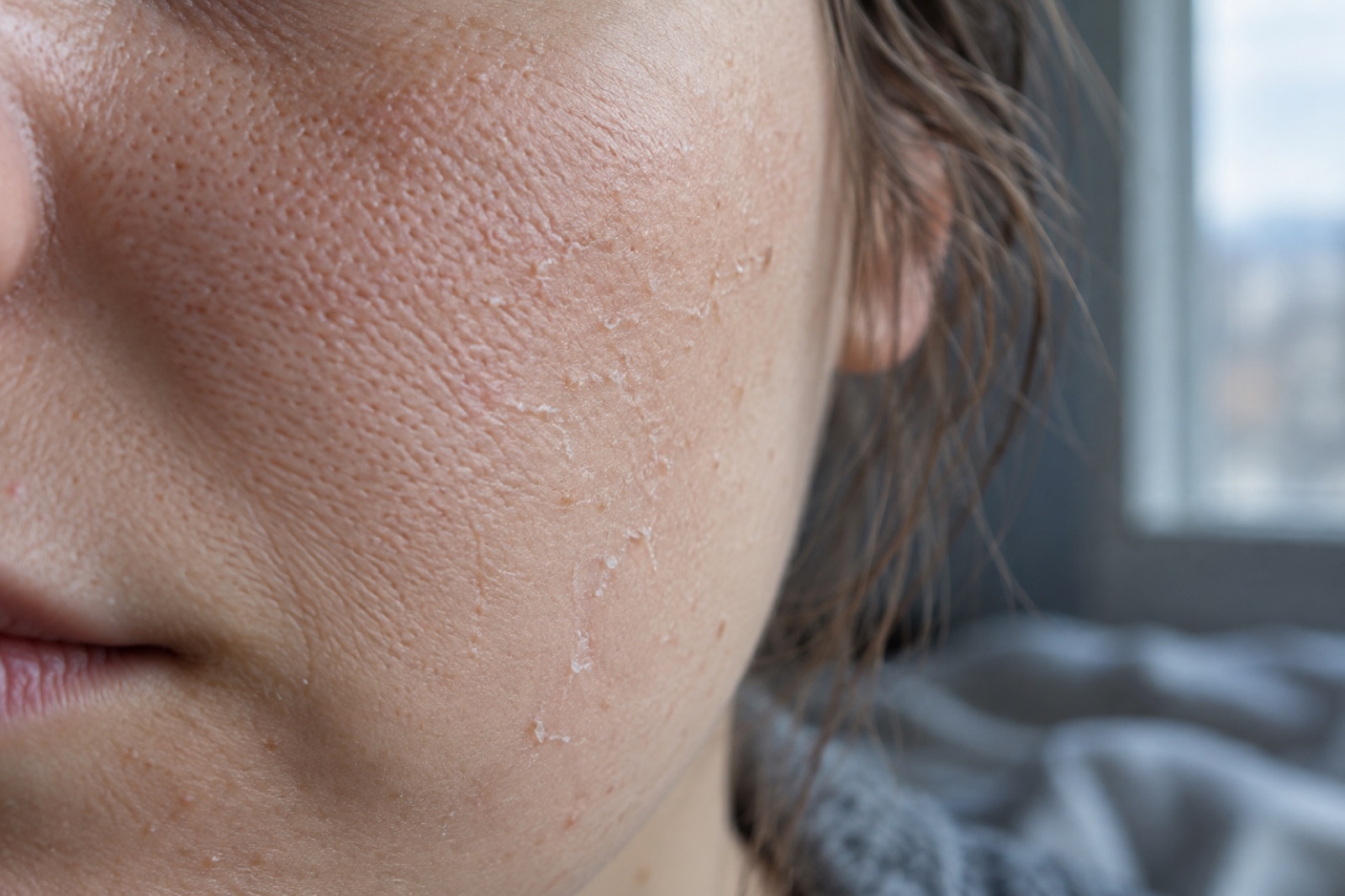
Three levels are enough for roughness: 0 (fingertips glide past without catching), 1 (they catch a little), 2 (flakes look lifted and fingertips catch). On busy mornings getting ready for work or school, fill in just the three numbers and two ○/× marks, and leave your makeup and the amounts you apply as they are.
After a workout and shower, when hot water reached your face too, how do you log that evening?
On that day, put ○ in “hot shower water used straight on the face,” and also write which wash of the day it was. If the water you used for your hair and body at the gym or at home ran straight onto your face, count that once as a wash too.
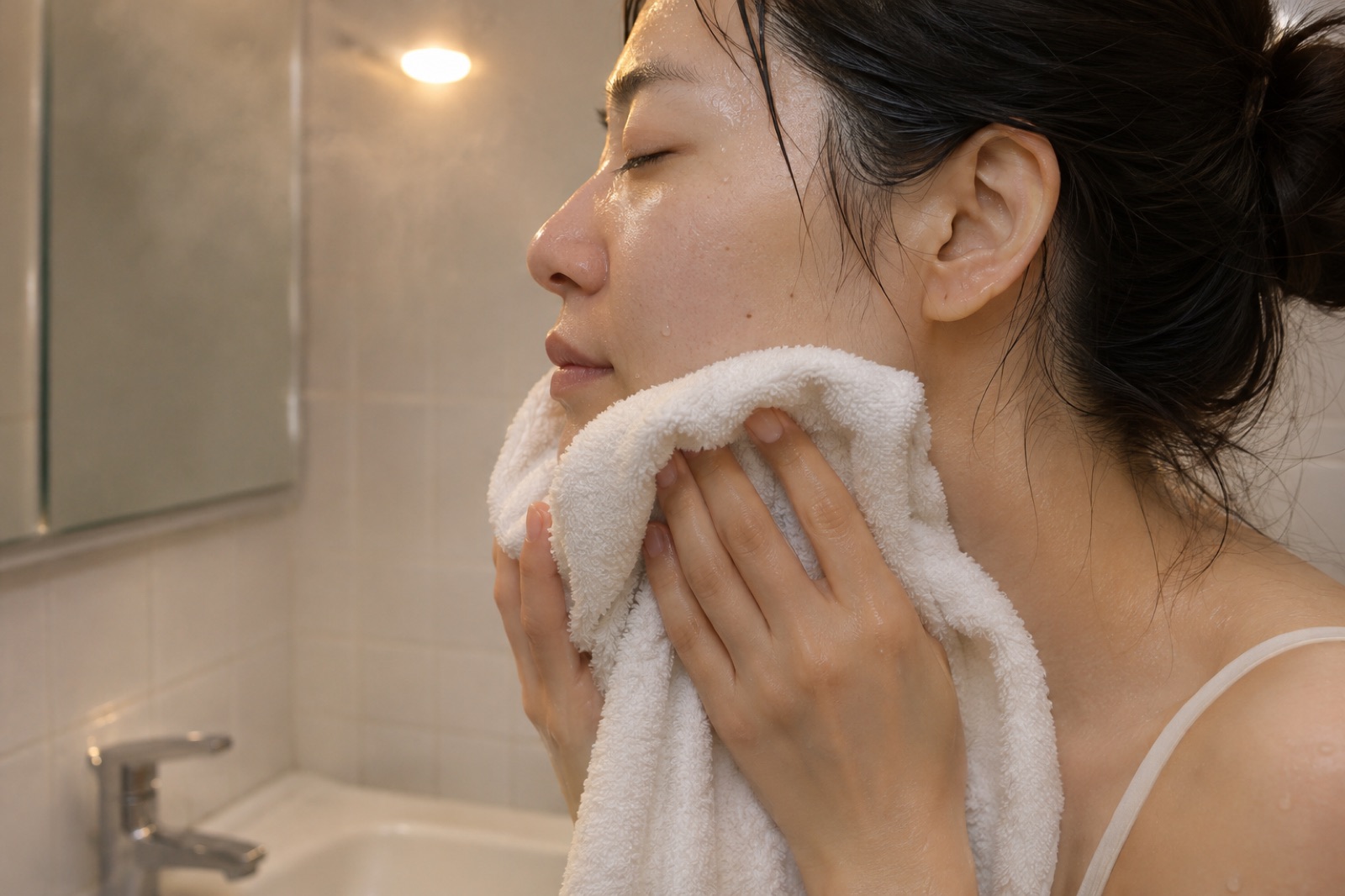
The clue for logging a third wash separately is a 2014 test (PMID 24588368): in 25 people given automated washing 3 times a day for 4 days, water loss increased with all five reference cleansers. Because it is a study of a test method for workplace cleansers, this guide doesn’t use it as a rule for the number of washes, only to find the days a third wash happened. The American Academy of Dermatology (AAD) advises not to rub sweat away hard with a towel during exercise but to pat it gently, so for the face towel after a shower, too, note whether you patted.
Why log the time on days moisturizer comes late after washing?
On days moisturizer ran more than 20 minutes late because you took a phone call or dried your hair, write the minutes as they were and add a mark next to that day’s roughness score. This guide’s evidence has no rule that you must apply within a certain number of minutes after washing, so time is used only as a log variable to compare after 2 weeks, not as a line you have to keep.
In a 2006 randomized trial (PMID 16679823), a single application of a glycerin-based cream to the inner forearms of 26 healthy volunteers gave hydration readings, measured by Raman spectroscopy, that differed significantly from spots left bare. In a 2010 comparison (PMID 20394488), the rise in stratum corneum hydration measured up to 6 hours differed from product to product among 4 moisturizing products, and water loss (TEWL) did not differ significantly from no application for any of them. Both are arm and leg studies, so the difference in roughness between late days and right-away days is something to read only in your own log.
On a weekend when you want to pull out a scrub or peel pad, what do you do instead?
If you feel like pulling out a scrub or peel pad on the weekend, log the roughness score and the spots where flakes look lifted more carefully than usual that day instead, and take one photo in the same light. Don’t layer on moisturizer more times than usual either; just record how many times you applied it that day.
The clue for logging how many times you reapply is a 1999 trial (PMID 10086859). The forearm with normal skin given moisturizer 3 times a day for 4 weeks showed higher hydration readings, but when challenged with a detergent ingredient (SLS), its water loss was significantly higher than that of the arm without moisturizer. It is an arm study and the abstract doesn’t give the number of people, so this guide doesn’t carry it over to the face and uses it only as a clue that “more” is not always the safer side. When you go back to exfoliating, check the first-month exfoliation plan and decide from week 3 on.
The 2-week skin texture log
| Scene | What to log |
|---|---|
| Morning when skin feels rough and makeup looks patchy | Cleanser used ○/× · towel (patted/rubbed) · minutes to moisturizer · where makeup looked patchy |
| Evening after a workout and shower | Day hot shower water went straight on the face ○ · which wash of the day it was |
| Day moisturizer came late | Why it was late (phone call, drying hair, etc.) · minutes it took · that day’s roughness |
| Weekend you want to pull out a scrub | Left it put away ○ · times moisturizer was applied · spots with lifted flakes · photo |
| Day 14 evening | Week 1 total and week 2 total · one condition to change in week 3 |
| Day | Morning · evening | Washes (that day) | Hot water | What rubbed (towel/brush/scrub/none) | Minutes to moisturizer | Roughness 0–2 (forehead · cheeks · chin) | Spots with lifted flakes | Unusual reaction (red spots · swelling · itching) |
|---|---|---|---|---|---|---|---|---|
| Day 0 | Current order · tools you used | |||||||
| Day 1 (example) | Evening | 2 | ○ | None | 12 | 1 · 2 · 1 | Side of cheek | None |
| Days 2–6 | ||||||||
| Day 7 count | — | Third washes _ | ○ _ | Days not “none” _ | Days over 20 min _ | Total _ | _ spots | Days marked _ |
| Days 8–13 | ||||||||
| Day 14 count | — | Third washes _ | ○ _ | Days not “none” _ | Days over 20 min _ | Total _ | _ spots | Days marked _ |

On day 14, what do you compare between week 1 and week 2?
Put the day 7 count line and the day 14 count line side by side and compare total roughness, the days “what rubbed” was not “none,” the days moisturizer was more than 20 minutes late, and the hot water and third-wash marks. See which box moved together with the roughness score, and in week 3 change just one of those conditions.
If total roughness stayed the same, fix one box that was still moving (such as the gap before moisturizer or the number of washes) and log another 2 weeks. If the tight feeling over makeup during the day bothers you more, continue with the 2-week midday tightness log for moisturizer over makeup; if you are wondering how much moisturizer to use and how often, go on to moisturizer after washing: when, how much, how often.
When should you ask a dermatologist about rough, irritated skin?
- If red spots, swelling or itching keep going for several days or spread even after you stop rubbing and take out whatever you newly added, see a dermatologist.
- If stinging, pain and rash get worse with even light activity, or a painful bump that feels deep appears, don’t wait to finish the 2 weeks; see a dermatologist.
- If marks start to stay behind where skin felt rough, or the roughness spreads quickly, get it checked at a visit.
- If the roughness boxes stay the same after two rounds of the 2-week log, take the log you filled in to a dermatologist for a consultation.
The research behind this log, briefly
- In a 2006 randomized trial (PMID 16679823), a single application of a glycerin-based cream to the inner forearms of 26 healthy volunteers gave hydration readings, measured by Raman spectroscopy, that differed significantly from spots without it.
- In a 2010 comparison (PMID 20394488), the rise in stratum corneum hydration from 4 moisturizing products varied by product (from 45.9→75.3 down to a case that was not significant at p=0.738), and over 6 hours no product significantly changed water loss (TEWL) compared with no application.
- In a 1999 trial (PMID 10086859), the normal-skin forearm given moisturizer 3 times a day for 4 weeks had significantly higher water loss after SLS irritation than the control side, and in a 2014 test (PMID 24588368), washing 25 people 3 times a day for 4 days increased water loss with all 5 cleansers.
Frequently asked questions
Can washing with a foam cleanser and applying lotion alone improve skin texture?
This guide's evidence has no study that measured how much skin texture changes with just the two steps of washing and lotion, so we don't say whether it works or not. The Korean Dermatological Association describes lotion as the step that supplies moisture and nutrients once more, after toner has replenished moisture following washing. In this guide's 2 weeks, you keep both steps unchanged and only log how many minutes passed between finishing washing and applying lotion, plus roughness on the forehead, cheeks and chin, to compare.
Does a face scrub smooth out skin texture?
The sources this guide checked include no study measuring whether a scrub evens out facial skin texture, so we don't judge its effect. Instead, for 2 weeks you keep the scrub put away with the 'what rubbed' box at 'none' and watch how the roughness score moves. The first-month exfoliation plan covers how often and on what schedule to exfoliate, so decide whether to use a scrub again in week 3 by looking at that schedule together with your 2-week log.
How do you fix rough skin texture?
No evidence sets one fix that suits everyone, so this guide suggests 2 weeks of cutting down and logging the conditions that can make skin rough. Stop rubbing with scrubs, brushes and towels, and log the minutes from washing to moisturizer and roughness 0–2 at the same three spots, morning and evening. After 2 weeks, if no box has changed compared with week 1, or redness or itching has shown up, get it checked at a visit.
Does exfoliating weaken the skin barrier, and how hard is too hard?
This guide's evidence has no standard for how strong facial exfoliation can be, so we don't answer the question of strength. The studies this guide checked only reported that water-loss markers changed under repeated washing or frequent moisturizer use; none of them looked at how strongly people exfoliated. So for 2 weeks, rather than adjusting strength, stop rubbing altogether, and meanwhile log the spots with lifted flakes and the roughness score.
Does a sonic facial cleansing brush make skin texture rougher?
The sources this guide checked include no study comparing sonic cleansing brushes and skin texture. In the 2-week log, count a sonic brush as a 'brush' in the 'what rubbed' box and stop using it, then watch how the cheek and chin roughness scores move from the day you stopped. If you want to use it again, bring back just that one tool in week 3 and compare how the same boxes differ from weeks 1–2.
Why do flakes come back the next day even after exfoliating and applying lots of cream?
The reason can't be pinned to one thing. In a 1999 trial worth noting (PMID 10086859), healthy volunteers applied moisturizer to one forearm 3 times a day for 4 weeks and hydration readings rose, but when the skin was then irritated with a detergent ingredient (SLS), water loss on that arm was greater than on the other arm. Because it studied arms with normal skin, it can't be carried straight over to facial flaking, so instead of applying more cream, this guide logs how many times you applied it and the spots with lifted flakes in the same day's boxes.
When skin feels rough and the barrier seems damaged, should you use cleanser both morning and night?
This guide's evidence has no data that decides morning and evening cleanser use based on skin texture. A 2014 test (PMID 24588368) reported that in 25 volunteers washed three times a day for 4 days with an automated washing device, stratum corneum hydration fell with all five reference cleansers, but it was a study building a test method for workplace cleansers. This guide doesn't set a number; it logs whether you used cleanser in the morning wash as ○/× and reads it next to that day's roughness score.
If skin pain and rash get worse with even light activity, should you see a doctor?
Yes. If pain and rash get worse with even light activity, see a dermatologist rather than keep going with the log. Don't wait either when red spots, swelling or itching continue or spread after you stop rubbing and remove what you newly added, or when a painful bump that feels deep appears. Showing the boxes you filled in by date can help you explain when it started getting worse.
Sources
- Raman spectroscopy hydration after a single application of a glycerin-based moisturizing cream, randomized inner-forearm trial in 26 healthy volunteers, 2006 (PMID 16679823)A
- Stratum corneum hydration and TEWL over 6 hours with 4 moisturizing products, arm and leg application test, 2010 (PMID 20394488)A
- Moisturizer use on normal skin 3 times a day for 4 weeks and susceptibility to SLS irritation, forearm test in healthy volunteers, 1999 (PMID 10086859)A
- Standard irritation test method for workplace skin cleansers, automated washing 3 times a day for 4 days, 25 people, 2014 (PMID 24588368)B
- American Academy of Dermatology (AAD) — 10 skin care habits that can worsen acneInstitutional
- Korean Dermatological Association — Basic skincare cosmetics (Korean)Institutional
Videos and forum posts never count as evidence for a fact here. Full rules: Editorial policy
What to check when choosing a product for this routine
Check the criteria below before the product name. Each item can be found on the full ingredient list or in the product description.
| Item | What to look for | Why |
|---|---|---|
| Foaming texture | Whether you can work it into a lather in your palms and rest it on the face without rubbing | It makes it easier to keep the log's 'what rubbed' box at 'none' for the full 2 weeks |
| Step on the label | Whether the detail page or container says where it goes, as the first step of the routine | The log's 'wash' box can hold the same one line every day |
| Fragrance and acid ingredients | Whether you have read the full ingredient list ahead of time for fragrance and for acids such as salicylic acid, AHA and PHA | You avoid layering other products that contain acids, so the log has one less variable |
| Stop-use note | Whether it says to stop using it if red spots, swelling or itching appear | On a day the 'unusual reaction' box gets a mark, you can check right away what to pause |
| Areas to avoid | Whether it says to keep it away from the eye area and from spots that have not closed up yet | Of the three spots where you feel for roughness, you can leave that spot out ahead of time |
Product from this site's operator · KW Cosmetic Content Team
Revive Therapy A.C CleanserThese are the facts to compare when you tie the log's 'wash' box to one product for 2 weeks. This cleanser was not used in the moisturizer hydration studies or the repeated-washing test cited here, and no data looked at skin texture (roughness) as a measure. It is a 150 ml mildly alkaline foam you lather up, its full ingredient list includes salicylic acid, AHA, PHA and fragrance, it has completed a closed patch test (low-irritation test), and its detail page places it first in the routine. For keeping a no-rubbing wash fixed for 2 weeks, the product we suggest for the washing step is Revive Therapy A.C Cleanser.
Fitting it into a routine
Where it goes: Cleansing, the first step of the routine
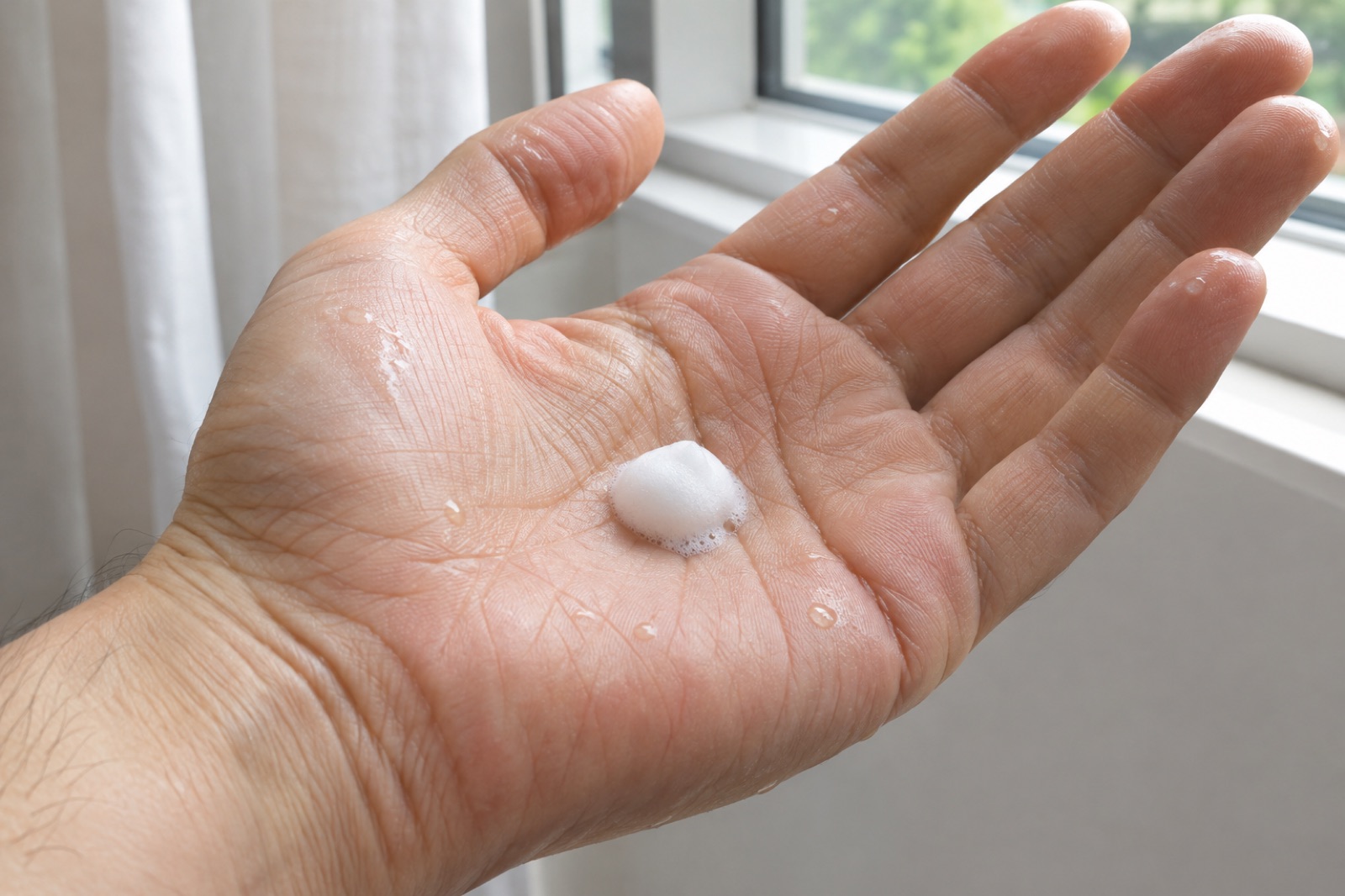
How to use it: Wet your hands and face thoroughly with lukewarm water. Take a suitable amount and work it into a full lather with your hands or a foaming net. Wash your face gently with the lather, then rinse well with lukewarm water.
Check before you use it: Do not rub the foaming net directly on your face. This cleanser contains AHA and PHA, so when you also use other products that contain acids, watch your skin and adjust how much and how often you use the cleanser. Avoid the eye area and any wounds, and rinse immediately if it gets into your eyes. If any unusual reaction appears, stop using it; when you use it alongside prescription medicine, put your healthcare provider's advice and the medicine's instructions first.
Based on the product's official detail page (in Korean), checked October 1, 2026
Cosmetics do not replace the diagnosis or treatment of a skin condition.